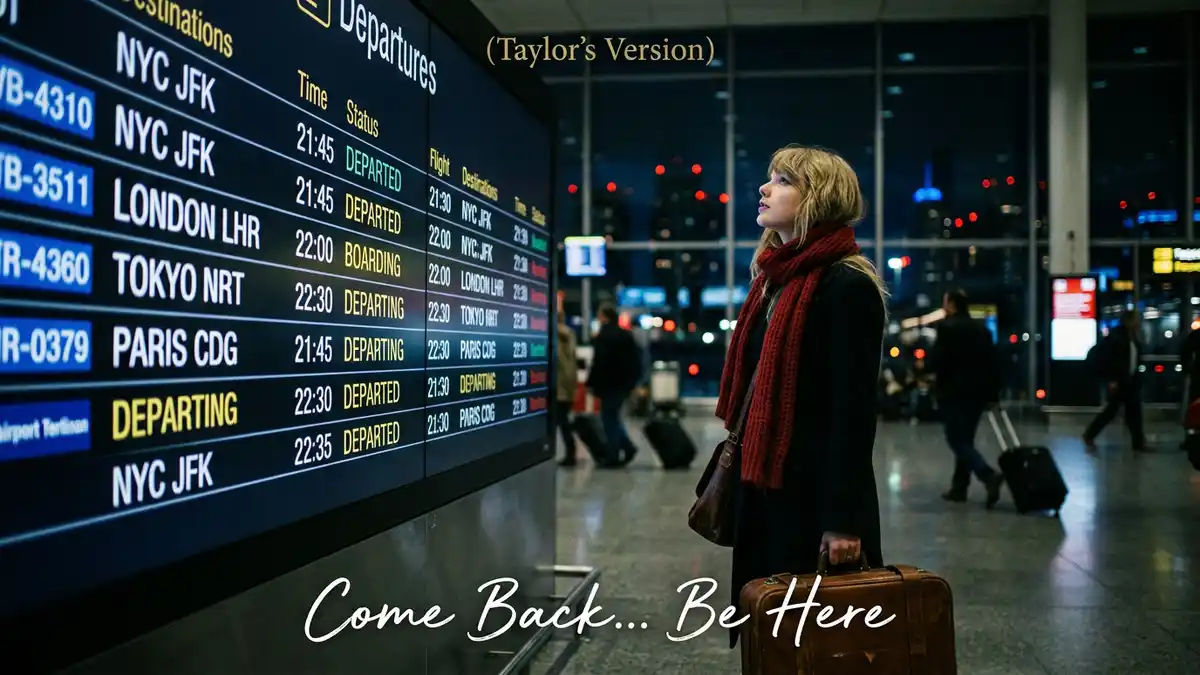

Red (Taylor’s Version) landed November 12, 2021, as a sprawling revisit of an album famous for emotional extremes. Nestled among its deluxe-era gems, “Come Back… Be Here (Taylor’s Version)” distills long-distance longing into a midtempo ache—city names as mile markers, time zones as emotional weapons. Taylor Swift re-sings the track with the same desperate patience that made it a fan anthem, now under a master recording she controls after years of public debate about her early catalog.
About Come Back… Be Here (Taylor’s Version)
The song first reached many listeners through deluxe editions of 2012’s Red, a period when Swift was expanding her sonic palette while maintaining the diary-close storytelling that defined her country-to-pop transition. The Taylor’s Version initiative followed disputes tied to ownership of her original masters, including the sale of Big Machine’s recordings and Swift’s vocal criticism of the resulting control structure involving Scooter Braun. Re-recording gave Swift a practical path forward: duplicate recordings, owned by her, competing ethically and commercially with the originals.
“Come Back… Be Here (Taylor’s Version)” keeps the original’s blend of intimate verses and a chorus that feels like a wish shouted down a phone line. Subtle updates in vocal tone and mixing highlight Swift’s matured instrument—slightly richer low notes, a more controlled emotional vibrato—without altering the song’s core identity as a relationship drama about distance rather than betrayal.
For readers interested in neutral background on master recordings and catalog sales in the music industry, Wikipedia’s article on master recordings explains basic terminology that helps clarify why re-recording projects matter to artists and listeners alike.
The ellipsis in the title mirrors modern texting grammar—an unfinished thought sent into the void—so the song feels oddly prescient in an era of constant digital contact that still cannot fix physical distance. On Red (Taylor’s Version), that contemporary resonance pairs with a classic Swift melodic lift: the chorus aches, but it also insists on naming the problem plainly.
Come Back… Be Here (Taylor’s Version) Lyrics
Lyrics belong in the placeholder section below.
[Verse 1]
You said it in a simple way, 4 am, the second day
How strange that I don’t know you at all
Stumbled through the long goodbye
One last kiss, then catch your flight
Right when I was just about to fall
[Pre-Chorus]
I told myself don’t get attached
But in my mind I play it back
Spinning faster than the plane that took you…
[Chorus]
And this is when the feeling sinks in
I don’t wanna miss you like this
Come back… Be here, come back… Be here
I guess you’re in New York today
I don’t wanna need you this way
Come back… Be here, come back… Be here
[Verse 2]
The delicate beginning rush
The feeling you can know so much
Without knowing anything at all
And now that I can put this down
If I had known what I’d known now
I never would have played so nonchalant
[Pre-Chorus]
Taxi cabs and busy streets
That never bring you back to me
I can’t help but wish you took me with you…
[Chorus]
And this is when the feeling sinks in
I don’t wanna miss you like this
Come back… Be here, come back… Be here
I guess you’re in London today
I don’t wanna need you this way
Come back… Be here, come back… Be here
[Bridge]
This is falling in love in the cruelest way
This is falling for you and you are worlds away
New York… Be here
But you’re in London and I break down
‘Cause it’s not fair that you’re not around
[Final Chorus]
This is when the feeling sinks in
I don’t wanna miss you like this
Come back… Be here, come back… Be here
I guess you’re in New York today
And I don’t wanna need you this way
Come back… Be here, come back… Be here
[Outro]
I don’t wanna miss you like this
Come back… Be here
Come back… Be here
Meaning and Analysis
Long-distance songs often romanticize travel or lean into melodrama; “Come Back… Be Here” chooses a more grounded frustration. The narrator is not performing tragedy for an audience—she is stuck in the ordinary mechanics of separation: planes, trains, schedules, and the cruel gap between wanting someone present and knowing they cannot be. Swift’s placement of specific locations turns abstraction into something map-like, as if the listener can trace the disconnect.
The title’s ellipsis captures the song’s emotional grammar: an unfinished command, a plea that cannot be completed because the situation has no tidy solution. The chorus reads like language you text at 1 a.m. when you are too tired to be eloquent but too awake to pretend you are fine. That conversational bluntness is a Swift strength—she lets the lyric sound like something a real person would say, not only a polished poem.
Musically, the track’s steady pulse mimics waiting—foot tapping, clock watching—while the melody climbs into urgency at the hook. On Red (Taylor’s Version), those dynamics feel a touch more cinematic, as if the narrator has had years to replay the scenario in her head. The song becomes both memory and renewed statement: still missing, still wishing, still naming cities like evidence.
Within the album’s tapestry, “Come Back… Be Here” complements other Red explorations of love under pressure, but its focus on geography and timing gives it a distinct identity. It is less about the explosive fight and more about the quiet erosion of not being in the same room—an increasingly relatable theme in a hyperconnected world that still cannot solve physical absence.
Frequently Asked Questions
What is “Come Back… Be Here (Taylor’s Version)” about?
It is about missing someone across distance and struggling with the frustration of separation when you desperately want them to be present.
Was this song on the standard Red tracklist originally?
It was associated with deluxe editions of Red and appears on the expanded Red (Taylor’s Version) release.
When was Red (Taylor’s Version) released?
The album was released on November 12, 2021.
Why is Taylor’s Version important?
It provides recordings Swift owns, offering fans and licensors an alternative to her original Big Machine-era masters after highly publicized ownership disputes.