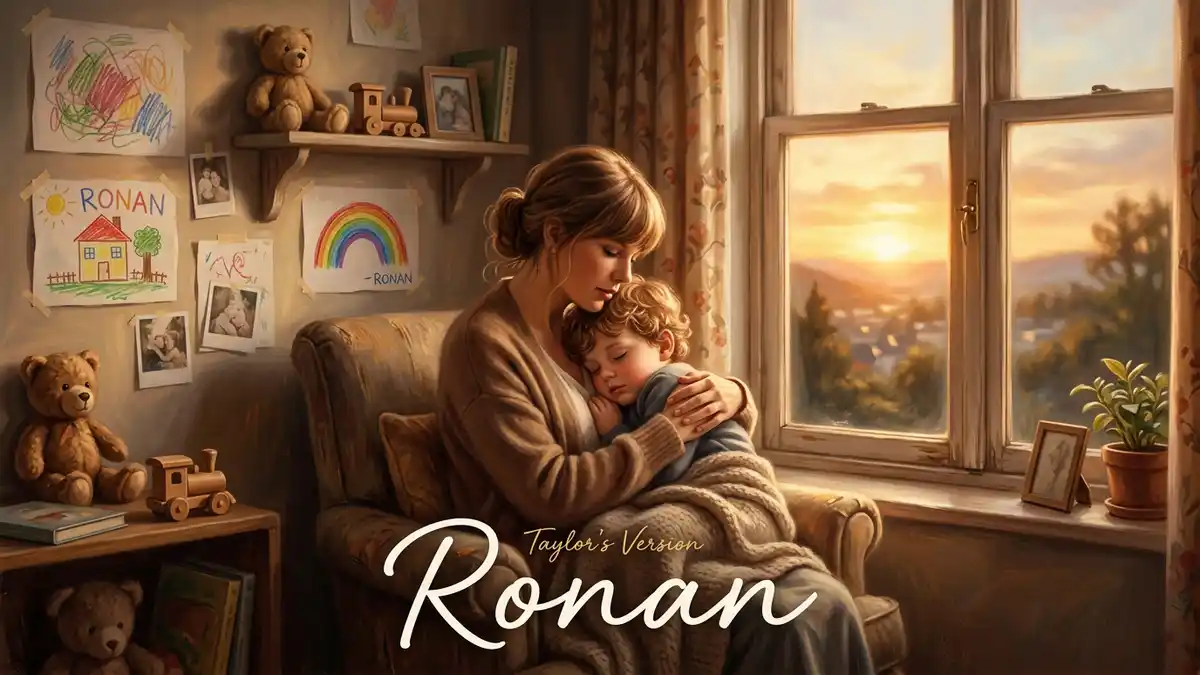

Among the most emotionally weighty inclusions on Red (Taylor’s Version)—released November 12, 2021—is “Ronan (Taylor’s Version),” a song that stands apart from the album’s romantic narratives. Originally released in 2012 as a charity single honoring a young child who died of cancer, the track draws language from his mother’s public writing, transforming grief into art with consent and care. Hearing it again as a Taylor’s Version recording connects Swift’s catalog reclamation project to a broader tradition of music as memorial and fundraiser.
About Ronan (Taylor’s Version)
“Ronan” began as a standalone charity release tied to cancer awareness and fundraising, separate from the standard Red rollout yet spiritually aligned with Swift’s reputation for narrative songwriting. Its inclusion on Red (Taylor’s Version) places the song alongside Swift’s re-recorded masters initiative—an effort that took on urgency after disputes over ownership of her early recordings, including the sale of Big Machine’s catalog and Swift’s public statements about wanting control of her work. While many Taylor’s Version tracks are discussed in terms of industry conflict, “Ronan” reminds listeners that the project also preserves songs whose meaning is primarily human rather than commercial.
Swift wrote the song using phrasing associated with Maya Thompson’s blog reflections on her son Ronan; Thompson received a co-writing credit. That detail matters ethically and artistically: the song is not speculative fiction about grief—it is anchored in a real family’s experience, offered to channel attention toward a cause. On Taylor’s Version, Swift’s matured vocal performance can heighten the tenderness without turning pain into spectacle; the arrangement remains restrained, keeping focus on the words.
Readers seeking authoritative background on childhood cancer as a public health topic may consult National Cancer Institute information on childhood cancers, which explains categories and research contexts in clinical terms. For general biographical context on Swift’s charitable releases, Wikipedia’s article on Taylor Swift summarizes widely cited milestones, including charity singles.
Ronan (Taylor’s Version) Lyrics
Lyrics will be inserted in the placeholder below, respecting the song’s sensitive origins.
[Verse 1]
I remember your bare feet down the hallway
I remember your little laugh
Race cars on the kitchen floor, plastic dinosaurs
I love you to the moon and back
I remember your blue eyes lookin’ into mine
Like we had our own secret club
I remember you dancin’ before bedtime
Then jumpin’ on me, wakin’ me up
I can still feel you hold my hand, little man
And even the moment I knew
You fought it hard like an army guy
Remember I leaned in and whispered to you
[Chorus]
Come on, baby, with me
We’re gonna fly away from here
You were my best four years
[Verse 2]
I remember the drive home, when the blind hope
Turned to cryin’ and screamin’, “Why?”
Flowers pile up in the worst way, no one knows what to say
About a beautiful boy who died
And it’s about to be Halloween
You could be anything you wanted if you were still here
I remember the last day, when I kissed your face
And whispered in your ear
[Chorus]
Come on, baby, with me
We’re gonna fly away from here
Out of this curtained room
And this hospital gray, we’ll just disappear
Come on, baby, with me
We’re gonna fly away from here
You were my best four years
[Bridge]
What if I’m standin’ in your closet tryin’ to talk to you?
And what if I kept the hand-me-downs you won’t grow into?
And what if I really thought some miracle would see us through?
What if the miracle was even gettin’ one moment with you?
[Outro]
Come on, baby, with me
We’re gonna fly away from here
Come on, baby, with me
We’re gonna fly away from here
You were my best four years
I remember your bare feet down the hallway
I love you to the moon and back
Meaning and Analysis
“Ronan” is not a metaphorical breakup ballad; it is a lament structured around memory, detail, and the unbearable asymmetry of a life ended too soon. Swift’s language stays small and concrete— the kind of images parents hold when love becomes remembrance. The effect is deliberately unguarded: there is no clever twist that redeems the situation, no narrative device that makes loss tidy. The song asks the listener to sit with sorrow quietly, without demanding a lesson that disrespects the reality of grief.
Because the lyric draws from a mother’s voice, the narrator’s perspective blurs the line between Swift as performer and Swift as conduit. The songwriting choice honors Thompson’s lived expression while using music’s capacity to widen empathy. Fans often describe listening as an act of witness rather than entertainment—an important distinction when discussing the track responsibly. The Taylor’s Version recording reiterates that witness years later, suggesting that some songs remain relevant not because they trend, but because loss remains a communal fact.
Musically, restraint is the point. A song like this does not need maximal production; it needs space for breath, pauses that feel like crying, and a melody that can carry tenderness without polishing away pain. Swift’s vocal approach on the re-recording tends to emphasize clarity and gentleness—an adult steadiness holding a child-sized story.
Within Red (Taylor’s Version), “Ronan” changes the album’s temperature. Surrounded by songs about love’s chaos, it offers a sobering reminder of what actually matters beyond celebrity narratives. It also complicates simplistic framings of the Taylor’s Version project as only industry drama: at its best, the re-recording campaign is also about stewardship—keeping meaningful work alive under the artist’s care. Taylor Swift fans approaching this article for lyrics or analysis should treat the subject with sensitivity: share thoughtfully, support reputable cancer charities if moved to do so, and remember the real family behind the song.
Frequently Asked Questions
Who is “Ronan” about?
The song honors Ronan Thompson, a young boy who died from cancer; Swift incorporated wording tied to his mother Maya Thompson’s writing, with Thompson credited as a co-writer.
Was “Ronan” originally on Red?
It debuted as a separate charity single in 2012 and later appeared on Red (Taylor’s Version) as part of the expanded re-recorded album.
When was Red (Taylor’s Version) released?
The album was released on November 12, 2021.
Why include “Ronan” on Taylor’s Version?
Including the track preserves an important, charity-connected song under Swift’s owned recording while continuing to raise awareness through her platform.