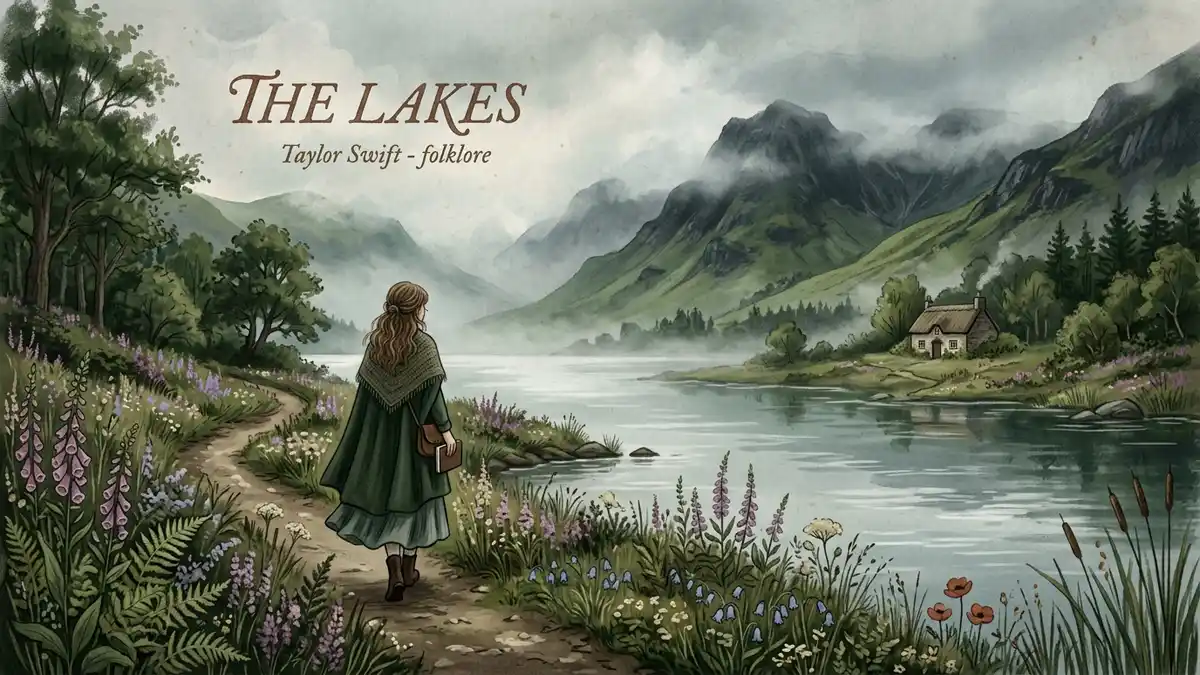

Hidden at the end of the deluxe edition of Taylor Swift‘s Folklore lies “the lakes,” a bonus track that many fans consider the album’s crowning lyrical achievement. The the lakes Taylor Swift lyrics transport the listener to the Lake District in northern England, the storied home of Romantic poets like William Wordsworth and John Keats, as Swift fantasizes about abandoning the noise of modern fame for a life of quiet literary solitude. Released as part of the deluxe edition of Swift’s surprise quarantine album on July 24, 2020, “the lakes” was written by Swift and Aaron Dessner of The National. With its orchestral flourishes, dense poetic imagery, and unabashedly literary references, the song stands apart from the rest of Folklore as its most ambitious and linguistically complex composition.
About the lakes
“the lakes” is the seventeenth and final track on the deluxe edition of Folklore, included as a bonus song that was not part of the standard tracklist. The song was written by Taylor Swift and Aaron Dessner, continuing their prolific collaboration that produced the majority of the album. The track draws its inspiration from the Lake District, a mountainous region in northwest England that became the spiritual and creative home of the English Romantic poets in the late eighteenth and early nineteenth centuries. William Wordsworth lived there for most of his life, composing some of the most celebrated poetry in the English language amid its landscapes. John Keats visited the region and found it transformative. Swift, a lifelong reader and self-described lover of poetry, channels this literary heritage into a song that imagines escaping the digital age for the analog beauty of the natural world.
The production of “the lakes” distinguishes it from much of Folklore. While the album predominantly features intimate, folk-influenced arrangements, “the lakes” incorporates sweeping orchestral elements — strings, brass, and layered vocal harmonies — that give it a grander, more cinematic quality. Dessner has described the track as one of the more elaborate productions from the Folklore sessions, noting that the orchestral arrangement was designed to evoke the majesty of the landscapes Swift describes in her lyrics. Swift’s vocal performance matches this ambition: she sings with a clarity and projection that contrasts with the whispered intimacy of tracks like “peace” and “hoax,” as though the Lake District’s open spaces have given her voice room to expand and breathe.
As a bonus track, “the lakes” occupies a unique position within the Folklore project. It exists outside the main album’s narrative architecture, which means it operates with a freedom that the other tracks do not enjoy. Where songs like “betty” and “cardigan” serve specific roles within interconnected storylines, “the lakes” is beholden to nothing but its own vision. This liberty allowed Swift to indulge her most literary impulses without concern for how the song fits into a broader tracklist. The result is arguably the most lyrically dense song in her entire discography — a track where every line is loaded with allusion, metaphor, and double meaning. Critics and fans alike have praised it as evidence of Swift’s evolution from pop hitmaker to genuine literary voice in contemporary songwriting.
the lakes Lyrics
Is it romantic how all my elegies
Eulogize me?
I’m not cut out for all these cynical clones
These hunters with cell phones
Take me to the Lakes
Where all the poets went to die
I don’t belong
And, my beloved, neither do you
Those Windermere peaks
Look like a perfect place to cry
I’m setting off
But not without my muse
What should be over
Burrowed under my skin
In heart-stopping waves of hurt
I’ve come too far to watch some name-dropping sleaze
Tell me what are my words worth
Take me to the Lakes
Where all the poets went to die
I don’t belong
And, my beloved, neither do you
Those Windermere peaks
Look like a perfect place to cry
I’m setting off
But not without my muse
I want auroras and sad prose
I want to watch wisteria grow
Right over my bare feet
‘Cause I haven’t moved in years
And I want you right here
A red rose grew up out of ice frozen ground
With no one around to tweet it
While I bathe in cliffside pools
With my calamitous love and insurmountable grief
Take me to the Lakes
Where all the poets went to die
I don’t belong
And, my beloved, neither do you
Those Windermere peaks
Look like a perfect place to cry
I’m setting off
But not without my muse
No, not without you
Meaning and Analysis of the lakes
“the lakes” is fundamentally a song about escape — but not the impulsive, reckless escape of running away. Instead, it envisions a deliberate withdrawal from the machinery of modern celebrity into a world where creativity and love can exist without surveillance. The Lake District functions as both a literal destination and a metaphor for an idealized existence free from social media, tabloid culture, and the performative demands of public life. Swift references “the old poets” who retreated to these landscapes to write, suggesting that true artistic expression requires distance from the noise of the world. The song’s most quoted line — “take me to the lakes where all the poets went to die” — is not morbid but aspirational, invoking the Romantic tradition of finding meaning in nature’s permanence rather than society’s chaos.
The literary references in “the lakes” are more explicit than anywhere else in Swift’s catalog. The mention of “a red rose” evokes Robert Burns, while the broader themes of nature as sanctuary and society as corruption echo Wordsworth’s philosophical framework in poems like “Lines Composed a Few Miles Above Tintern Abbey.” Swift also weaves in references to the specific challenges of her own life — “those Windermere peaks look like a perfect place to cry” balances the beautiful with the sorrowful, acknowledging that the desire to escape comes from genuine pain. The song is not naive about the realities of the world; it simply argues that there must be a place beyond them, and that love deserves a setting more generous than the one fame provides.
What makes “the lakes” such a fitting capstone to the Folklore era is that it articulates the emotional and artistic philosophy that underpins the entire album. Folklore was itself an act of escape — Swift retreating from the demands of pop stardom to create something quieter, more introspective, and more literarily ambitious than anything she had attempted before. “the lakes” makes this subtext explicit. It is a mission statement disguised as a love song, declaring that Swift’s truest self exists not in the spotlight but in the margins, among books and nature and the kind of love that does not require an audience. The orchestral production reinforces this sense of grandeur and finality, building to a climax that feels like the last page of a novel — complete, satisfying, and leaving the reader forever changed. As the final word on Folklore‘s deluxe edition, “the lakes” is nothing less than a declaration of artistic identity from a songwriter who has proven, once and for all, that she contains multitudes.
FAQs about the lakes
Who wrote the lakes?
“the lakes” was written by Taylor Swift and Aaron Dessner. The song features orchestral production elements that set it apart from the more minimalist arrangements found on the rest of the Folklore album.
What is the lakes about?
“the lakes” is about the desire to escape the pressures of modern fame and retreat to a simpler, more poetic existence. The song references the Lake District in England, where Romantic poets like William Wordsworth and John Keats found creative inspiration in nature.
What is the Lake District?
The Lake District is a mountainous region in northwest England known for its lakes, forests, and dramatic landscapes. It was home to several of the most important English Romantic poets, including William Wordsworth, Samuel Taylor Coleridge, and Robert Southey, and is now a UNESCO World Heritage Site.
Is the lakes a bonus track?
Yes, “the lakes” is a bonus track available exclusively on the deluxe edition of Folklore. It is the seventeenth and final track on the deluxe version, following “hoax,” which closes the standard sixteen-track edition of the album.