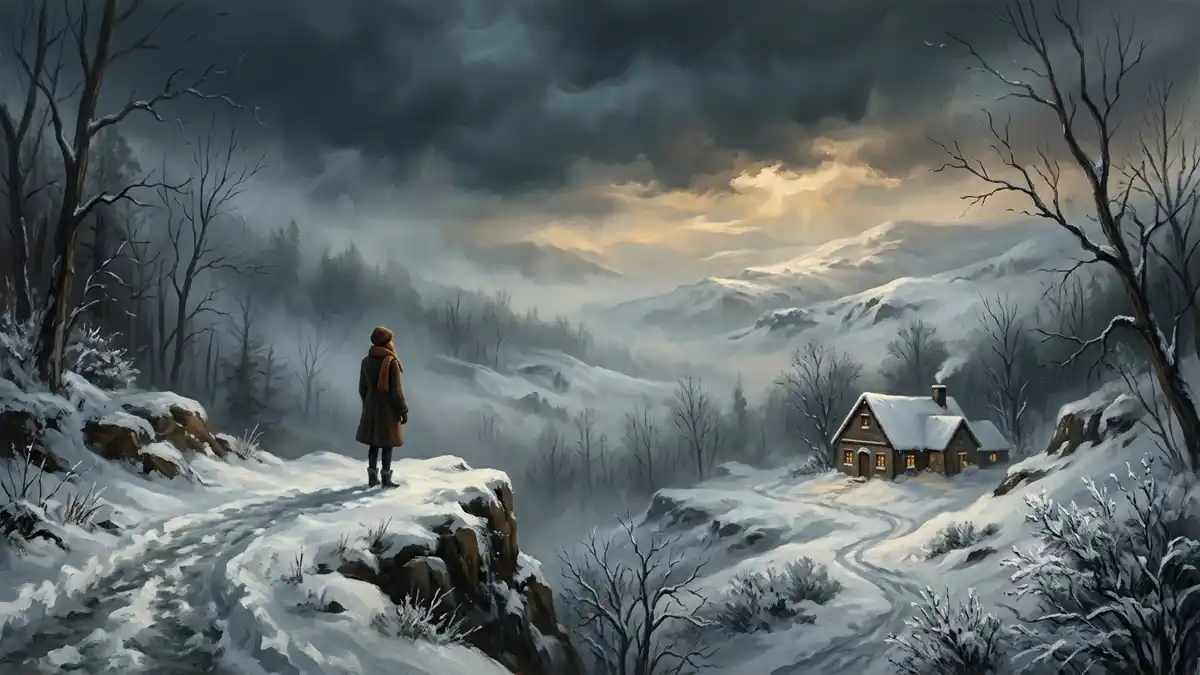

Evermore Taylor Swift lyrics belong to the title track—and emotional summit—of Swift’s ninth studio album, Evermore, released December 11, 2020. A sister record to Folklore, the project blends indie folk, alternative rock, and chamber pop while leaning heavily on Aaron Dessner’s organic production and Swift’s sharpened storytelling. The album’s closing statement (on the standard tracklist) is a duet with Bon Iver’s Justin Vernon, whose falsetto answers Swift’s verses like a second weather system moving through the same storm. If you are reading this guide alongside Taylor Swift discography deep-dives, think of “evermore” as the moment the album admits despair can feel endless—then quietly opens a door to hope.
About evermore
As track 15, “evermore” carries the weight of a finale: not a fireworks ending, but a slow clearing. Aaron Dessner’s production frames the song as a late-night conversation between two voices exhausted by feeling. Swift’s piano-led melody and restrained phrasing keep the focus on emotional precision, while the arrangement swells with the kind of careful orchestration that defines much of Evermore’s chamber-pop identity. When Vernon enters, the texture shifts—his falsetto provides contrast and lift, a sonic embodiment of another perspective stepping into the narrator’s isolation.
The collaboration makes sense in the context of the album’s sonic world. Bon Iver’s history of blending folk intimacy with experimental atmosphere aligns with the Folklore/Evermore era’s priorities: emotion first, genre second. Jack Antonoff’s influence appears elsewhere on Swift’s ninth album, but this track’s DNA reads as Dessner-country: patient builds, earthy drums, and space that feels like breath fogging cold air. The result is a duet that functions as both climax and resolution—an admission that pain can feel perpetual, paired with the possibility that “always” can transform from a trap into a bridge.
Thematically, naming the album after this song signals Swift’s intent to explore endurance: not the Instagram-friendly kind, but the stubborn, unglamorous kind that keeps you upright when joy is scarce. Sitting alongside alternative-leaning cuts and folk narratives, “evermore” refuses to rush the listener toward sunshine. Instead, it lets winter last long enough to feel real—then allows a subtle harmonic shift to suggest that spring might be credible, not merely obligatory.
evermore Lyrics
Gray November, I’ve been down since July
Motion capture put me in a bad light
I replay my footsteps on each stepping stone
Trying to find the one where I went wrong
Writing letters addressed to the fire
And I was catching my breath
Staring out an open window, catching my death
And I couldn’t be sure, I had a feeling so peculiar
That this pain would be for evermore
Hey, December, guess I’m feeling unmoored
Can’t remember what I used to fight for
I rewind the tape, but all it does is pause
On the very moment all was lost
Sending signals to be double-crossed
And I was catching my breath
Barefoot in the wildest winter, catching my death
And I couldn’t be sure, I had a feeling so peculiar
That this pain would be for evermore
(Evermore)
Can’t not think of all the cost
And the things that will be lost
Oh, can we just get a pause
To be certain we’ll be tall again?
Whether weather be the frost
Or the violence of the dog days
I’m on waves, out being tossed
Is there a line that I could just go cross?
And when I was shipwrecked (can’t think of all the cost)
I thought of you (all the things that will be lost now)
In the cracks of light (can we just get a pause)
I dreamed of you (to be certain we’ll be tall again?)
(If you think of all the costs) it was real enough
(Whether weather be the frost) to get me through
(Or the violence of the dog days) or the violence of the dog days
(Out on waves, being tossed) (I’m on waves, out being tossed) I swear
(Is there a line that we could just go cross?) You were there
And I was catching my breath
Floors of a cabin creaking under my step
And I couldn’t be sure, I had a feeling so peculiar
This pain wouldn’t be for evermore
Evermore (evermore)
Evermore
This pain wouldn’t be for evermore (ooh)
Evermore
Meaning and Analysis
On a lyrical level, “evermore” dramatizes depression’s time distortion: the sense that grief or anxiety stretches without a horizon. Swift’s images—gray skies, numb routine, a heart stuck on repeat—map cleanly onto that psychological experience without reducing it to a slogan. The title word becomes a double-edged symbol: it can mean eternal sorrow, or it can mean a love or commitment that outlasts a cruel season. The song’s power is that it holds both meanings at once until the arrangement gently tilts toward relief.
Vernon’s sections deepen the analysis by introducing dialogue rather than monologue. Where Swift’s narrator may feel sealed inside her own head, the duet form implies that suffering can be witnessed—and sometimes loosened—through connection. His falsetto is not just a pretty texture; it reads as vulnerability answering vulnerability, a sonic choice that makes hope feel less like a lecture and more like a hand offered in the dark. In that sense, “evermore” is less about “getting over it” than about believing the weather can change even when you cannot yet feel the warmth.
Finally, as the title track of Swift’s ninth studio album, the song redefines what an “era” can sound like. Evermore is often discussed as a companion piece, but its closing gesture insists on its own identity: mature, patient, willing to sit with discomfort. For fans analyzing Swift’s evolution, “evermore” is a key text—proof that her blockbuster storytelling could expand into indie-adjacent spaces without losing clarity, and that her definition of pop catharsis could include quiet duets, slow burns, and the courage to end an album with a question dissolving into light.
Frequently Asked Questions
Who sings on “evermore” with Taylor Swift?
Justin Vernon of Bon Iver is featured on the track. His falsetto contrasts with Swift’s vocals and helps shape the song’s emotional arc.
Who produced the title track “evermore”?
Aaron Dessner produced “evermore,” aligning with the song’s indie-folk and chamber-pop instrumentation on Evermore, released December 11, 2020.
What is the meaning of “evermore” on the album?
The song explores emotional pain that feels endless, then moves toward hope. The title reflects endurance and the sense of time stretching during grief or depression.
Is “evermore” the last song on the standard Evermore tracklist?
Yes. As track 15, it serves as the standard edition’s closing song and functions as an emotional climax for the album.