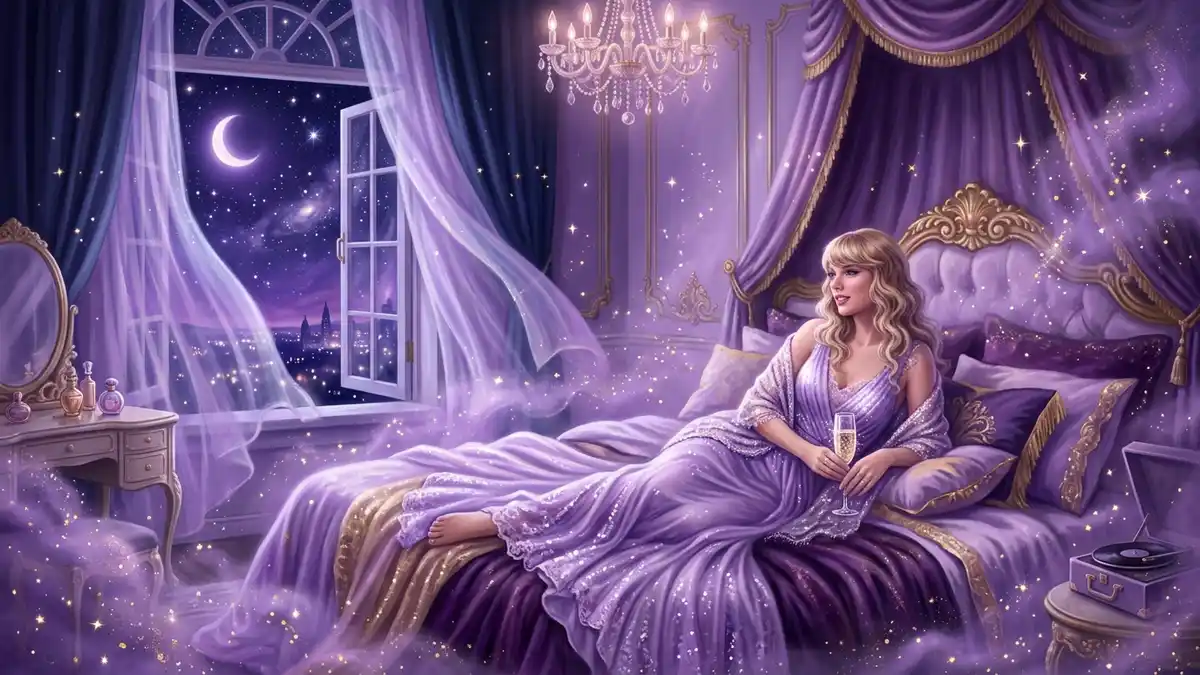

If you are looking for Lavender Haze Taylor Swift lyrics alongside context about how the song fits into her tenth studio era, you have come to the right place. Lavender Haze Taylor Swift lyrics capture a synth-drenched, late-night mood that opens Midnights (2022) with intention and atmosphere. Released on October 21, 2022, the track immediately signals the album’s fascination with sleepless thoughts, private feelings, and the stories we tell ourselves after dark. Below, you will find background on the song’s creation, a dedicated lyrics section, and a closer read of its themes—plus answers to common fan questions.
Table of Contents
About Lavender Haze
Lavender Haze is the opening track on Midnights, Taylor Swift’s tenth studio album. The record, which arrived on October 21, 2022, is widely described as a concept album about the thoughts that surface at midnight—restlessness, longing, regret, and quiet triumph. Placing Lavender Haze at track one frames the listening experience like stepping into a colored fog: the production is dreamy, synth-forward, and deliberately cinematic, setting expectations for an album that values mood as much as narrative clarity. For a broader overview of the project’s rollout, track listing, and reception, the Midnights album Wikipedia page offers a helpful, well-sourced summary.
The title phrase’s pop-culture lineage is part of the song’s public story. Swift has discussed hearing “lavender haze” on Mad Men, where it is used to describe the glow of being deeply in love—an almost intoxicated romantic fog. She connected the expression to the feeling of wanting to protect a relationship from outside noise, especially the constant hum of speculation, commentary, and judgment that can surround a public life. That intersection—private tenderness versus external scrutiny—becomes a central tension in the songwriting.
Lavender Haze was written with Jack Antonoff, who is a defining creative partner across much of Swift’s later work, alongside additional collaborators including Zoë Kravitz and others credited on the release. Antonoff’s production fingerprints—warm synth pads, pulsing low end, and a sense of space—help the track feel both intimate and expansive. Rather than presenting love as a simple fairytale, the song leans into a more adult, atmospheric pop palette: it is seductive and a little dangerous, like staying up too late on purpose because the feeling is too good to interrupt.
Commercially, the song made an immediate impact. It debuted at number two on the Billboard Hot 100, a striking launch for an album opener and a testament to how eagerly audiences were waiting for new Swift material in the Midnights era. That chart performance also reflects how Swift’s storytelling and sonic branding can turn a relatively abstract phrase into a widely shared reference point. On the album sequence, starting with Lavender Haze signals that Midnights will explore emotional shades—lavender, maroon, midnight blue—rather than relying on a single, blunt metaphor.
Lavender Haze Lyrics
(Meet me at midnight)
(Oh, oh, oh)
(Oh, oh, oh)
(Oh, oh, oh)
(Woah, woah, woah, woah, woah)
Staring at the ceiling with you
Oh, you don’t ever say too much
And you don’t really read into
My melancholia
I been under scrutiny (yeah, oh, yeah)
You handle it beautifully (yeah, oh, yeah)
All this shit is new to me (yeah, oh, yeah)
I feel the lavender haze creeping up on me
Surreal
I’m damned if I do give a damn what people say
No deal
The 1950s shit they want from me
I just wanna stay in that lavender haze
(Oh, oh, oh)
(Oh, oh, oh)
(Woah, woah, woah, woah, woah)
All they keep asking me (all they keep asking me)
Is if I’m gonna be your bride
The only kind of girl they see (the only kind of girl they see)
Is a one-night or a wife
I find it dizzying (yeah, oh, yeah)
They’re bringing up my history (yeah, oh, yeah)
But you weren’t even listening (yeah, oh, yeah)
I feel the lavender haze creeping up on me
Surreal
I’m damned if I do give a damn what people say
No deal
The 1950s shit they want from me
I just wanna stay in that lavender haze
(Oh, oh, oh)
The lavender haze (oh, oh, oh)
(Woah, woah, woah, woah, woah)
Talk your talk and go viral (oh, oh, oh)
I just need this love spiral (oh, oh, oh)
Get it off your chest (woah, woah, woah, woah)
Get it off my desk (get it off my desk)
Talk your talk and go viral (oh, oh, oh)
I just need this love spiral (oh, oh, oh)
Get it off your chest
Get it off my desk
I feel the lavender haze creeping up on me (I feel)
Surreal
I’m damned if I do give a damn what people say
No deal (no deal)
The 1950s shit they want from me
I just wanna stay in that lavender haze (oh, oh)
(Oh, oh, oh)
(Oh, oh, oh)
Get it off your chest (woah, woah, woah, woah)
Get it off my desk
The lavender haze (oh, oh, oh)
I just wanna stay (oh, oh, oh)
I just wanna stay in that lavender haze
Meaning and Analysis
Read as a lyric essay on boundaries, Lavender Haze Taylor Swift lyrics repeatedly return to the idea of a relationship as a sanctuary. The “haze” is not only romantic intoxication; it is also a kind of shield—something soft enough to blur harsh light but thick enough to keep intruders at a distance. In that reading, the song is less about proving love to the world and more about refusing to translate private happiness into a public debate. The synth-pop setting reinforces this: the sound is smooth and continuous, like a loop you do not want to end, which mirrors the lyrical insistence on staying inside the feeling.
The contrast between the dream state and the “1950s” pressure Swift references in promotional conversation also sharpens the song’s cultural commentary. Listeners often hear Lavender Haze as pushing back against narrow expectations—especially the idea that romance must follow an old script, complete with prescribed roles and outside approval. By choosing a phrase borrowed from television and elevating it into a pop chorus, Swift collapses high art and mass media into one emotional language, which is a recurring move in her catalog: take a small phrase, enlarge it, and let it carry an entire mood.
Finally, the track’s placement at the beginning of Midnights matters for interpretation. Many albums use their first song as a thesis; here, the thesis is tenderness under surveillance. Later songs on the record will explore shame, ambition, nostalgia, and self-critique, but Lavender Haze begins the night with desire and defiance intertwined. That sequencing encourages listeners to hear the rest of the album as a series of midnight rooms—each with a different emotional temperature—rather than a single story with one moral.
FAQs
What album is Lavender Haze on?
Lavender Haze is the opening track on Taylor Swift’s tenth studio album, Midnights, released on October 21, 2022.
Why is the song called Lavender Haze?
The title references a phrase Taylor Swift encountered in popular culture (notably linked to Mad Men) describing the dreamy, all-consuming feeling of being in love, which she connected to protecting a relationship from outside scrutiny.
Who wrote and produced Lavender Haze?
The song was written with Jack Antonoff and includes additional collaborators such as Zoë Kravitz (and other credited writers) depending on the release credits, with production commonly associated with Swift and Antonoff’s synth-pop approach on Midnights.
How did Lavender Haze perform on the charts?
Lavender Haze debuted at number two on the Billboard Hot 100, reflecting strong streaming and sales interest around the Midnights launch.