
If you are looking for Vigilante Shit Taylor Swift lyrics, this article breaks down one of the boldest sonic left turns on Midnights—a track that trades glittering confession for a bass-heavy, late-night swagger. “Vigilante Shit” is not trying to soothe you; it is trying to strut through the wreckage with a steady pulse and a steady gaze. Written entirely by Swift herself on the standard edition of the album, the song stands out as a rare solo composition in a collaborative era, which makes its voice feel even more deliberate.
Below you will learn how the song fits into Swift’s tenth studio album, find a reserved section for the full lyrics, explore what the track is doing narratively and stylistically, and review quick answers to common questions. Whether you are here for the production details, the revenge fantasy framing, or the way Swift plays with persona, the goal is to connect the listening experience to the album’s larger midnight mood.
Table of Contents
About Vigilante Shit
“Vigilante Shit” is the eighth track on Midnights, Taylor Swift’s tenth studio album, released October 21, 2022. The record is widely described as a concept album about sleepless nights—those hours when your mind replays conversations, rewrites endings, and sometimes imagines justice arriving on your terms. For a concise overview of the album’s background, chart performance, and track listing from a third-party reference perspective, the Midnights Wikipedia article is a useful companion while you read about individual songs.
On the standard edition of Midnights, “Vigilante Shit” is notable because Swift is credited as the sole writer. That detail matters to fans who study her discography as a map of creative partnerships: much of the album’s palette comes from collaboration, especially with producers who help shape texture and rhythm. Here, the solo writing credit suggests a tight, uncompromising statement—lines delivered with the confidence of someone who knows exactly what scene she is setting and refuses to soften the edges for daylight.
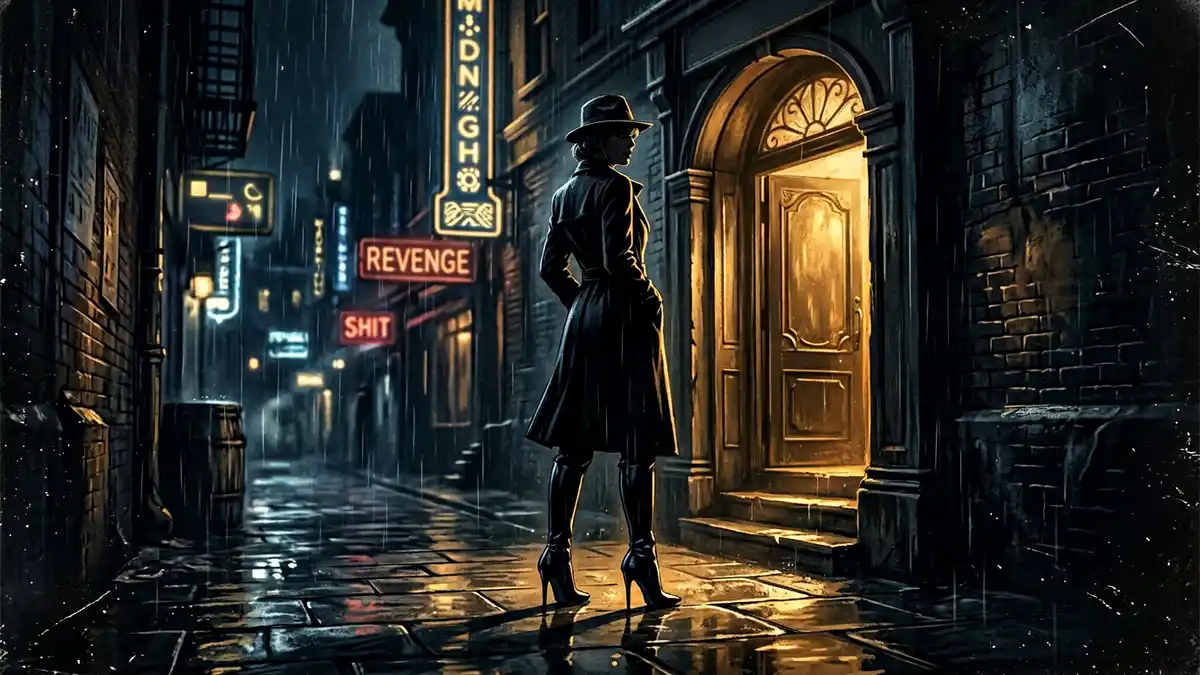
Production-wise, the song is often characterized as dark, minimal, and bass-forward. Instead of building toward a traditional singalong chorus, Swift and the track’s sonic architecture lean into repetition, attitude, and space. The absence of a conventional chorus is a feature, not a flaw: it keeps the listener in a sustained mood, like a slow pan across a neon-soaked alley. That choice reinforces the song’s noir-adjacent aesthetic, where the fantasy is not romance as much as consequence—someone who wronged her, or someone she cares about, facing a reckoning that arrives off-screen but feels inevitable.
Thematically, “Vigilante Shit” belongs to a lineage of Swift songs that flirt with revenge as narrative engine—not necessarily as a real-world instruction manual, but as a dramatic device that lets an artist explore anger, protection, and moral fantasy. Listeners often connect this mode to Swift’s long-standing interest in character work: she writes first-person songs that can be read as autobiographical, allegorical, or cinematic, depending on the lens you bring. Here, the title alone signals pulp energy, like a chapter title in a crime serial, while the performance invites you to inhabit a role for three minutes.
Within the album’s sequencing, “Vigilante Shit” arrives after several tracks that mix intimacy with pop brightness. Its stark tone can feel like a hard cut—lights dimmed, bass turned up, humor sharpened into something more dangerous. That contrast is part of Midnights as a whole: Swift moves through vulnerability, bravado, nostalgia, and fantasy, sometimes within the same song and sometimes by placing wildly different moods side by side. Track eight, in that sense, is a reminder that midnight thoughts are not only tender; sometimes they are tactical.
Vigilante Shit Lyrics
Draw the cat eye sharp enough to kill a man
You did some bad things, but I’m the worst of them
Sometimes I wonder which one will be your last lie
They say looks can kill, and I might try
I don’t dress for women, I don’t dress for men
Lately, I’ve been dressing for revenge
I don’t start shit, but I can tell you how it ends
Don’t get sad, get even
So on the weekends, I don’t dress for friends
Lately, I’ve been dressing for revenge
She needed a cold, hard proof, so I gave her some
She had the envelope, where you think she got it from?
Now she gets the house, gets the kids, gets the pride
Picture me, thick as thieves with your ex-wife
And she looks so pretty
Driving in your Benz
Lately, she’s been dressing for revenge
She don’t start shit, but she can tell you how it ends
Don’t get sad, get even
So on the weekends, she don’t dress for friends
Lately, she’s been dressing for revenge
Ladies always rise above
Ladies know what people want
Someone sweet, and kind, and fun
The lady simply had enough
While he was doing lines
And crossing all of mine
Someone told his white collar crimes to the FBI
And I don’t dress for villains
Or for innocents I’m on my vigilante shit again
I don’t start shit, but I can tell you how it ends
Don’t get sad, get even
So on the weekends, I don’t dress for friends
Lately, I’ve been dressing for revenge
Meaning and Analysis
“Vigilante Shit” works best when you treat it as performance art with a film-noir filter. The lyrics draw on imagery associated with power, secrecy, and payback, but the song’s power is as much about tone as plot. Swift’s delivery and the production’s restraint create a sense of control: the narrator sounds unbothered in the way someone sounds when they have decided they will not be the only person losing sleep anymore. That emotional stance—cool, clipped, confident—reads differently than a ballad that pleads for understanding, and it expands Swift’s range as a storyteller who can occupy multiple registers on one album.
The lack of a traditional chorus changes how repetition functions. Instead of a hook that releases tension, the track often circles motifs and phrases, keeping the listener locked in a mood state. That structure mirrors the vigilante fantasy itself: not a tidy resolution, but an ongoing stance. Fans who enjoy lyrical close reading can still hunt for double meanings and coded references, but the song also rewards a simpler read—it is a midnight revenge vignette, stylish and a little dangerous, meant to be felt in the body as much as decoded on a lyric sheet.
Finally, placing a solo-written track in the middle of a highly collaborative album highlights Swift’s ability to shift gears without breaking the project’s conceptual frame. Midnights is unified by time of night and emotional volatility, not by a single genre costume. “Vigilante Shit” proves that Swift’s midnight can include a bass pulse and a smirk, offering a different kind of catharsis than softer, more confessional tracks. It is a song that trusts the audience to follow the mood shift—and to understand that sometimes the story you tell at 1:00 a.m. is not the same story you tell in the morning.
FAQs
Did Taylor Swift write “Vigilante Shit” alone?
On the standard edition of Midnights, “Vigilante Shit” is credited as written solely by Taylor Swift, making it the only solo-written track on that edition.
What is “Vigilante Shit” about?
The song is widely interpreted as a dark, stylized revenge fantasy about confronting someone who caused harm—protective, confrontational, and framed with a noir-like attitude rather than a traditional pop narrative arc.
Does “Vigilante Shit” have a typical chorus?
Fans and critics often note that the track does not follow a conventional pop chorus structure, relying instead on a minimal, bass-heavy groove and repeated attitude-driven lines.
Where does “Vigilante Shit” appear on Midnights?
It is track 8 on Midnights, Taylor Swift’s tenth studio album, released on October 21, 2022.