
Anyone researching Cassandra Taylor Swift lyrics is stepping into myth, metaphor, and a cold kind of vindication. This article maps the song onto The Tortured Poets Department, explains its Greek legend roots, and unpacks why the track feels like a thunderclap in The Anthology. For a wider look at Swift’s story and releases, see Taylor Swift.
Table of Contents
About Cassandra
Cassandra is Anthology track 27 on The Tortured Poets Department, released April 19, 2024 as part of Swift’s surprise double drop. Sixteen songs anchor the primary album; the remaining fifteen—including Cassandra—make up The Anthology. That placement matters: by track twenty-seven, listeners have already moved through heartbreak, anger, and confession, so a mythic reckoning lands with accumulated weight.
The song is produced by Aaron Dessner with Swift, fitting the darker, stormier corridor of the record’s Dessner-helmed material. While Jack Antonoff co-produces many of the album’s poppier cuts, Dessner’s collaborations here often feel like stone and wind—percussion that hits like judgment, harmonies that widen into dread, and a vocal performance that balances control with barely contained fury.
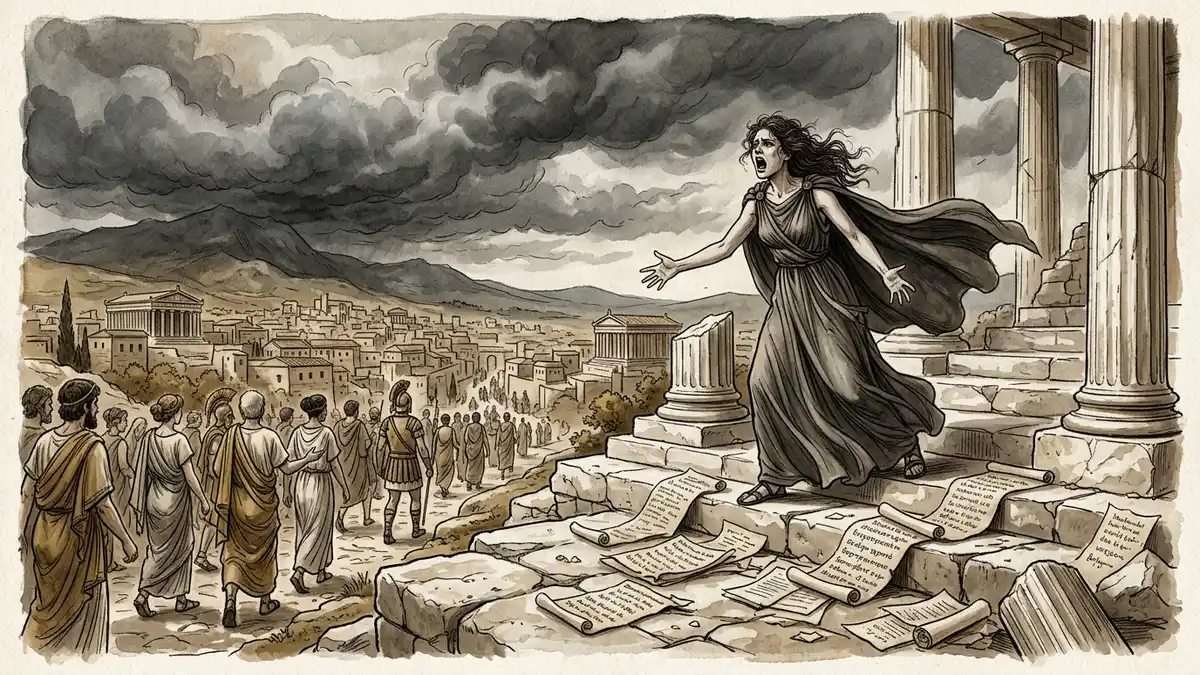
The title references the Greek myth of Cassandra, princess of Troy, who was cursed to utter true prophecies that no one would believe. Swift uses that framework to explore dismissal, smear campaigns, and the maddening experience of being treated as hysterical while history slowly proves you right. The myth gives the song intellectual spine: it is not merely a breakup story but a commentary on credibility and power.
As an Anthology bonus track, Cassandra also participates in the album’s literary branding—The Tortured Poets Department as a place where pain is cataloged with academic seriousness. Here, the poetry is ancient, and the department feels like a courtroom where the verdict arrives years late.
Cassandra Lyrics
I was in my new house placing daydreams
Patching up the crack along the wall
I pass it and lose track of what I’m saying
‘Cause that’s where I was when I got the call
When the first stone’s thrown, there’s screaming
In the streets, there’s a raging riot
When it’s: Burn the bitch!, they’re shrieking
When the truth comes out, it’s quiet
So they killed Cassandra first ’cause she feared the worst
And tried to tell the town
So they filled my cell with snakes, I regret to say
Do you believe me now?
I was in my tower weaving nightmares
Twisting all my smiles into snarls
They say what doesn’t kill you makes you aware
What happens if it becomes who you are?
So they killed Cassandra first ’cause she feared the worst
And tried to tell the town
So they set my life in flames, I regret to say
Do you believe me now?
They knew, they knew, they knew the whole time
That I was onto something
The family, the pure greed, the Christian chorus line
They all said nothing
Blood’s thick, but nothing like a payroll
Bet they never spared a prayer for my soul
You can mark my words that I said it first
In a mourning warning, no one heard
I patched up the crack along the wall
I pass it and lose track of what I’m saying
‘Cause that’s where I was when I lost it all
So they killed Cassandra first ’cause she feared the worst
And tried to tell the town
So they filled my cell with snakes, I regret to say
Do you believe me now?
Ah, ah-ah-ah, ah
I was onto something
Ah-ah-ah, ah
They all said nothing
Blood’s thick, but nothing like a payroll
Bet they never spared a prayer for my soul
You can mark my words that I said it first
In a mourning warning, no one heard
No one heard, not a single word was heard
When the first stone’s thrown, there’s screaming
In the streets, there’s a raging riot
When it’s: Burn the bitch!, they’re shrieking
When the truth comes out, it’s quiet
It’s so quiet
Meaning and Analysis
Swift’s use of Cassandra is not decorative; it is an argument about truth and audience. The myth’s cruelty is not only that Cassandra is wrong but that she is right and alone—punished twice, first by fate and then by social refusal. Translating that to a modern celebrity context, fans hear parallels to public disputes where evidence, nuance, and women’s testimony are debated as entertainment.
Lyrically, the song thrives on images of warning ignored: fires people refuse to see, voices discounted until the damage is undeniable. Dessner’s production underscores the epic scale—this is not a bedroom demo of sadness but a widescreen confrontation. The result is cathartic for listeners who have ever been gaslit, minimized, or told they were “too much” for naming reality.
At the same time, the track avoids turning myth into a simple hero-villain cartoon. Swift’s narrator sounds tired, not triumphant; being proven right after the fact can be hollow when the cost was years of reputational injury. That emotional complexity is what elevates Cassandra from gimmick to statement—an Anthology deep cut that feels destined for live-show drama.
Released alongside the full 31-song edition on April 19, 2024, Cassandra underscores how Swift used The Anthology to push mythology into modern celebrity language. Production-wise, Aaron Dessner’s collaboration with Swift gives the track a storm-system intensity that contrasts with some of the album’s Jack Antonoff-led sparkle—useful contrast on a double album that wants both confession-booth intimacy and arena-sized catharsis.
Readers who arrive via searches for Cassandra Taylor Swift lyrics may notice how Swift weaponizes classical reference without sounding like a textbook: the myth becomes a lens for credibility, gendered dismissal, and the cruel lag between truth and consensus. As Anthology track 27, the song also benefits from momentum—by this point in the 31-track journey, listeners have been trained to expect both literary games and blunt emotional receipts.
That cumulative listening effect is part of Swift’s double-album design on April 19, 2024: the first sixteen songs establish a world, and The Anthology complicates it with alternate angles, including this thunderous meditation on being unheard until history rearranges the scoreboard.
FAQs
What is the myth of Cassandra?
In Greek mythology, Cassandra was cursed to speak true prophecies that nobody believed. Swift uses this metaphor for being dismissed despite being right.
What album is Cassandra on?
Cassandra is Anthology track 27 on The Tortured Poets Department (2024), part of The Anthology bonus tracks released the same day as the main album.
Who produced Cassandra?
Aaron Dessner co-produced with Taylor Swift, giving the song a dark, atmospheric, and rhythmically intense feel.
What is Cassandra about?
The lyrics explore being disbelieved and dismissed until events prove the narrator correct—linking personal and public narratives of credibility and consequence.