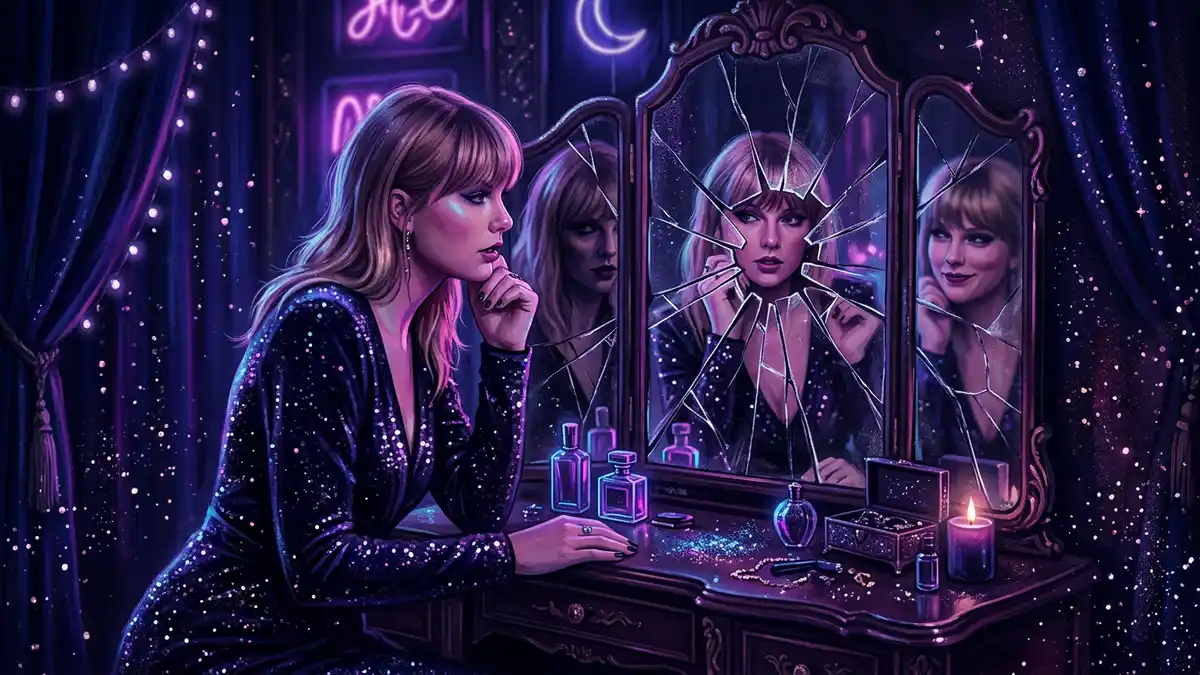

When people type Anti-Hero Taylor Swift lyrics into a search bar, they are usually looking for the exact words behind one of Midnights’ most quoted lines—plus some context about why the song became such a phenomenon. Anti-Hero Taylor Swift lyrics foreground self-interrogation with a darkly comic edge, and the track served as the album’s lead single after Taylor Swift released Midnights on October 21, 2022. As the third song on her tenth studio album, it sits at the center of a project about sleepless nights, intrusive thoughts, and the stories we tell when nobody is there to interrupt us.
Table of Contents
About Anti-Hero
Anti-Hero is track three on Midnights, Swift’s tenth studio album, which explores the emotional architecture of midnight: overthinking, longing, shame, defiance, and unexpected softness. Swift has described the song in promotional interviews as one of her most direct examinations of her own insecurities—an admission that is notable even in a catalog famous for self-aware songwriting. By placing that confession at the front of the album’s rollout as a lead single, Swift signaled that Midnights would engage with self-image not only as a narrative device but as a lived pressure—how it feels to be perceived, judged, and mythologized while still trying to remain human.
The track was co-written with Jack Antonoff, whose production on Swift’s recent eras often blends indie introspection with pop immediacy. Anti-Hero pairs conversational verses with a chorus that lands like a punchline and a thesis at once—memorable enough to travel across social media, yet emotionally legible enough to work as a standalone single. For readers seeking a concise overview of the album’s background and accolades, the Midnights album Wikipedia article provides a useful starting point with citations and chart data.
Commercially, Anti-Hero became a defining hit of the Midnights era. It debuted at number one on the Billboard Hot 100 and spent multiple weeks—widely reported as eight weeks—at the top, a rare sustained peak that reflects streaming dominance, radio uptake, and the song’s ubiquity in online conversation. The line “It’s me, hi, I’m the problem, it’s me” quickly became a cultural shorthand for self-accountability with a wink, appearing in memes, commentary, and everyday jokes. That kind of linguistic spread is difficult to manufacture; it tends to happen when a lyric compresses a recognizable feeling into a singable shape.
The song also received major industry recognition, including Grammy attention (nominated in prominent categories alongside other work from the era), which further cemented its status as more than a fleeting viral moment. On the album sequence, Anti-Hero follows the hazy romance of Lavender Haze and the saturated memory palette of Maroon, pivoting the record toward self-scrutiny—an important hinge for an album titled after the hour when intrusive thoughts can feel loudest.
Anti-Hero Lyrics
I have this thing where I get older, but just never wiser
Midnights become my afternoons
When my depression works the graveyard shift
All of the people I’ve ghosted stand there in the room
I should not be left to my own devices
They come with prices and vices
I end up in crisis
(Tale as old as time)
I wake up screaming from dreaming
One day I’ll watch as you’re leaving
‘Cause you got tired of my scheming
(For the last time)
It’s me, hi, I’m the problem, it’s me
At teatime, everybody agrees
I’ll stare directly at the Sun, but never in the mirror
It must be exhausting always rooting for the anti-hero
Sometimes I feel like everybody is a sexy baby
And I’m a monster on the hill
Too big to hang out, slowly lurching toward your favorite city
Pierced through the heart, but never killed
Did you hear my covert narcissism
Lightly disguised as altruism
Like some kind of congressman?
(Tale as old as time)
I wake up screaming from dreaming
One day I’ll watch as you’re leaving
And life will lose all of its meaning
(For the last time)
It’s me, hi, I’m the problem, it’s me (I’m the problem, it’s me)
At teatime, everybody agrees
I’ll stare directly at the Sun, but never in the mirror
It must be exhausting, always rooting for the anti-hero
I have this dream my daughter-in-law kills me for the money
She thinks I left them in the will
The family gathers around and reads it and someone screams out
She’s laughing up at us from hell
It’s me, hi, I’m the problem, it’s me
It’s me, hi, I’m the problem, it’s me
It’s me, hi, everybody agrees, everybody agrees
It’s me, hi, I’m the problem, it’s me (I’m the problem, it’s me)
At teatime, everybody agrees (everybody agrees)
I’ll stare directly at the Sun, but never in the mirror
It must be exhausting, always rooting for the anti-hero
Meaning and Analysis
Reading Anti-Hero Taylor Swift lyrics as literature means taking seriously the song’s blend of shame, humor, and hyperbole. Swift often uses exaggeration as an emotional truth-telling tool: the narrator says things that sound almost too blunt to be sung, then undercuts them with a melodic lift or a joke, which mirrors how people actually cope with self-doubt. The “anti-hero” framing is crucial because it rejects a spotless protagonist narrative. Instead, the song invites listeners into a messier contract: you can be successful, loved, and still frightened of your own reflection—or resentful, or self-sabotaging in ways you are not proud of.
The track also engages with fame as a distorting mirror. Even listeners who do not live in the public eye can recognize the core anxiety: the fear that people secretly dislike you, that your mistakes define you, or that your personality is “too much” for polite company. Swift’s writing compresses those fears into specific images and scenes rather than leaving them abstract, which is why the song functions as both pop spectacle and intimate confession. The production supports this duality—bright enough for radio, but with enough tension in the rhythm and tone to suggest unease beneath the gloss.
In the context of Midnights, Anti-Hero is not merely a single; it is a thematic key. The album returns repeatedly to the question of who you are when the day’s performance ends—when the notifications slow and you are alone with your thoughts. From that angle, the song’s famous hook is less a gimmick than a blunt act of naming: before you can soften your edges for public consumption, you admit the fear that you might be the common denominator in your own disasters. That is heavy subject matter for a singalong, which is exactly why it resonated so widely.
FAQs
Was Anti-Hero a single from Midnights?
Yes—Anti-Hero was released as the lead single from Midnights and became one of the era’s biggest commercial successes.
How did Anti-Hero perform on the Billboard Hot 100?
Anti-Hero debuted at number one on the Billboard Hot 100 and spent multiple weeks (commonly reported as eight) at the top.
What is the famous line in Anti-Hero?
The chorus includes the widely quoted phrase “It’s me, hi, I’m the problem, it’s me,” which became a major cultural reference point online and in media.
Who co-wrote Anti-Hero?
Anti-Hero was co-written by Taylor Swift and Jack Antonoff, continuing their collaborative work across Swift’s late-career albums.