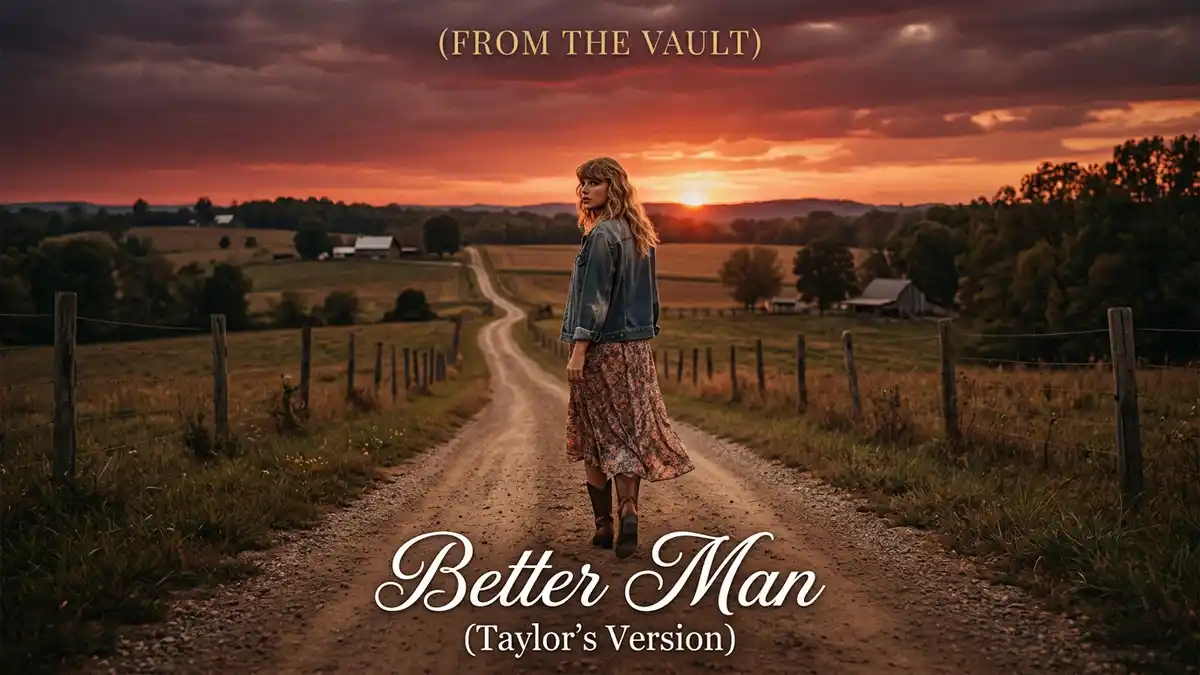

Better Man (Taylor’s Version) (From the Vault) is one of the most talked-about vault cuts on Red (Taylor’s Version)—not only because it finally lets fans hear Taylor Swift‘s own recording of a song that helped define modern country storytelling, but because its journey from the Red era to the world is unusually public. Written while Swift was shaping the emotional palette of her 2012 album but left off the original tracklist, the song later became a signature hit for Little Big Town before Swift reclaimed it for her November 12, 2021 re-recording project. Whether you know it from country radio or from Swift’s vault sequence, the lyric is a masterclass in regret framed as a simple, devastating wish: that someone had simply been kinder.
About Better Man (Taylor’s Version) (From the Vault)
“From the Vault” tracks on Red (Taylor’s Version) are songs Swift wrote during the original Red era (around 2011–2012) that did not appear on the 2012 album—often because of pacing, sequencing, or the sheer volume of material she was generating at the time. When Swift began re-recording her first six albums to own her masters, she used the expanded editions as a chance to release those unheard (or, in some cases, later-famous) compositions in versions that match her current era of production and vocal maturity.
“Better Man” is a standout example of how a vault song can exist in more than one life. Swift originally composed it during the Red period; the demo remained in her archives while the song found a second home with Little Big Town, whose recording became a major country single. The track’s craftsmanship—melodic lift in the chorus, conversational verses, and a hook that lands like a sigh—helped it earn significant recognition, including a CMA Awards-level spotlight for its songwriting strength. On Red (Taylor’s Version), Swift’s own interpretation returns the narrative voice to the person who first lived inside those lines, offering fans a direct line to the song’s emotional origin.
Collaboratively, the public story of “Better Man” is anchored in Swift’s authorship rather than a long list of studio partners on the vault cut itself; the song’s power is in its lyrics and melody, which balance country phrasing with the pop-aware melodic instincts that defined much of Red. Hearing Swift sing it herself reframes subtle choices—where she leans into softness, where she lets frustration sharpen a consonant—and makes the track feel like both a time capsule and a reassertion of creative ownership.
Better Man (Taylor’s Version) (From the Vault) Lyrics
The full lyrics to Better Man (Taylor’s Version) (From the Vault) appear below. Many listeners focus on the chorus’s plainspoken regret and the way Swift turns a relationship postmortem into something almost tender—an admission that the narrator would have stayed if the other person had been capable of basic decency.
[Verse 1]
I know I’m probably better off on my own
Than lovin’ a man who didn’t know
What he had when he had it
And I see the permanent damage you did to me
Never again, I just wish I could forget when it was magic
[Pre-Chorus]
I wish it wasn’t 4 a.m., standing in the mirror
Saying to myself, you know you had to do it
I know the bravest thing I ever did was run
[Chorus]
Sometimes, in the middle of the night, I can feel you again
But I just miss you, and I just wish you were a better man
But I know why we had to say goodbye like the back of my hand
But I just miss you, and I just wish you were a better man
A better man
[Verse 2]
I know I’m probably better off all alone
Than needing a man who could change his mind at any given minute
And it was always on your terms
I waited on every careless word
Hoping it might turn sweet again
Like it was in the beginning
[Pre-Chorus]
But your jealousy, oh, I can hear it now
Talking down to me like I’ll always be around
Push my love away like it was some kind of loaded gun
Oh, you never thought I’d run
[Chorus]
Sometimes, in the middle of the night, I can feel you again
But I just miss you, and I just wish you were a better man
But I know why we had to say goodbye like the back of my hand
But I just miss you, and I just wish you were a better man
A better man
[Bridge]
I hold onto this pride because these days it’s all I have
And I gave to you my best and we both know you can’t say that
I wish you were a better man
I wonder what we would’ve become
If you were a better man
[Outro]
We might still be in love
If you were a better man
You would’ve been the one
If you were a better man
Yeah, yeah
Sometimes, in the middle of the night, I can feel you again
But I just miss you, and I just wish you were a better man
But I know why we had to say goodbye like the back of my hand
But I just miss you and I just wish you were a better man
A better man
(Sometimes, in the middle of the night, I can feel you again)
We might still be in love, if you were a better man
(But I just miss you, and I just wish you were a better man)
Yeah, yeah
I know why we had to say goodbye like the back of my hand
But I just miss you and I just wish you were a better man
A better man
We might still be in love, if you were a better man
You would’ve been the one
If you were a better man
Meaning and Analysis
At its core, “Better Man” is a song about the gap between what you needed and what you got. The narrator is not begging for perfection; she is mourning the absence of baseline respect, consistency, and care. That distinction matters for how Swift’s writing lands emotionally: the lyric refuses melodrama in favor of specifics—small disappointments that accumulate until love feels impossible to justify. It is a breakup song that does not pretend the breakup was a mystery; it was inevitable because the other person refused to grow.
The title works as both accusation and wish. Saying you wish someone had been a “better man” is softer than a tirade, but it also implies a standard that was failed. Swift often excels at this kind of moral clarity without cruelty: the narrator can acknowledge her own attachment (“I know I’m probably better off”) while still honoring the pain of leaving. The tension between self-protection and lingering tenderness is what makes the song feel lived-in rather than merely clever.
Because fans first heard the song through another artist’s voice, Swift’s vault version invites comparison as interpretation rather than “correctness.” Different singers emphasize different colors—breathiness, grit, restraint—but Swift’s delivery tends to highlight the writerly details: conversational lines that sound like something you confess to a friend at 1 a.m., and a chorus that opens up like a release valve. In the context of Red‘s themes—memory, longing, the way romance can feel electrically urgent and then abruptly cold—”Better Man” fits neatly alongside tracks about aftermath and self-rescue.
Finally, the song resonates in broader conversations about songwriting and ownership. Swift’s choice to include it on Red (Taylor’s Version) underscores how a composition can have a public life while still belonging, creatively and emotionally, to its author. For listeners tracing Swift’s arc from country storytelling to global pop stardom, “Better Man” is a reminder that her narrative precision was already fully formed in the era when she was writing some of her most enduring heartbreak work.
Frequently Asked Questions
When was Better Man (Taylor’s Version) (From the Vault) released?
It was released on November 12, 2021, as part of Taylor Swift’s re-recorded album Red (Taylor’s Version), which includes From the Vault tracks from the original Red era.
Did Taylor Swift write Better Man during the Red era?
Yes. The song is widely understood to have been written during the Red writing period even though it did not appear on the 2012 album; it later became known to many fans through Little Big Town’s recording before Swift released her own Taylor’s Version.
What is Better Man about?
The lyrics center on leaving a relationship while wishing the other person had been kinder, more mature, and more dependable—capturing regret without romanticizing mistreatment.
Why is Better Man labeled From the Vault?
From the Vault songs were written around the time of the original album but not included on its standard tracklist; Swift added them to the Taylor’s Version editions to share more of that era’s songwriting archive.