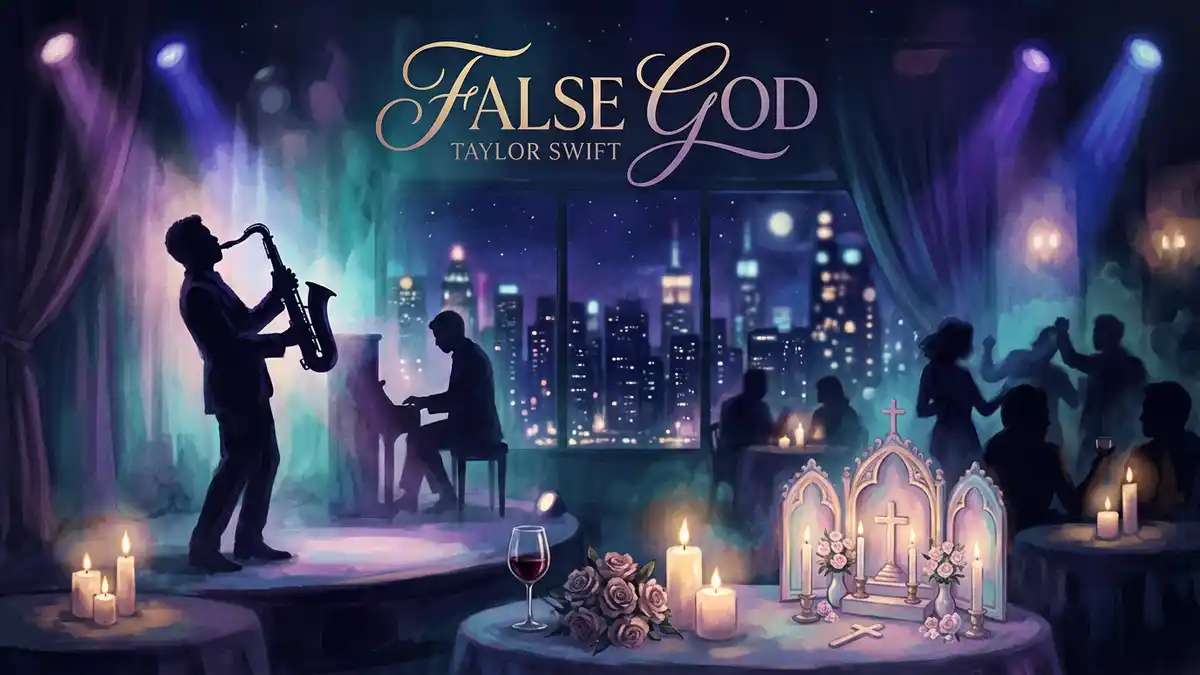

False God Taylor Swift Lyrics guide fans through one of the most atmospheric deep cuts on Lover (2019), where Taylor Swift frames desire, distance, and devotion in language borrowed from faith and ritual. The track stands apart on an album known for pastel romance and glittering pop hooks, trading maximalism for a smoky, jazz-leaning sound that feels deliberately grown-up.
Table of Contents
About False God
Released August 23, 2019, Lover was Taylor Swift’s seventh studio album—and a milestone as the first project she fully owned at release, coloring its storytelling with both playfulness and newfound creative control. Among its seventeen original tracks, “False God” arrives as a mood piece: produced by Jack Antonoff, it leans on warm pads, a steady pulse, and a prominent saxophone line that nudges the song toward alternative pop with a nocturnal, almost cinematic edge. Where other Lover songs chase daylight and butterflies, this one lingers after midnight.
Lyrically, Swift maps intimacy onto spiritual imagery—altars, heaven, worship—without pretending the relationship is simple. New York City surfaces as a literal and emotional geography: bridges, skylines, and the ache of being apart become part of the song’s texture. The result is mature and sensual, a track that treats physical connection and emotional risk as intertwined rather than purely celebratory. Fans often cite it as proof that Lover could hold more than bubblegum brightness; it could also hold ambiguity.
Antonoff’s production choices reinforce that ambiguity. The groove feels patient, almost devotional, as if the arrangement itself is breathing. The saxophone—an instrument more commonly associated with jazz, soul, and certain corners of pop history—signals sophistication and a willingness to step outside Swift’s most radio-friendly templates. In the context of 2019 pop, “False God” was a conversation starter: a star known for massive singles releasing a track that seemed designed for headphones, late drives, and repeated listens rather than instant TikTok clips.
On playlists and in live discussions, “False God” frequently earns “hidden gem” status. It is not the album’s lead narrative in the way “Cruel Summer” or “Lover” might be, but it deepens the record’s emotional range. It suggests that love, in Swift’s Lover era, could be sacred and flawed at once—something you kneel to even when you know the altar is made of human hands.
False God Lyrics
[Verse 1]
We were crazy to think
Crazy to think that this could work
Remember how I said I’d die for you?
We were stupid to jump
In the ocean separating us
Remember how I’d fly to you?
[Pre-Chorus]
And I can’t talk to you when you’re like this
Staring out the window like I’m not your favorite town
I’m New York City
I still do it for you, babe
[Chorus]
They all warned us about times like this
They say the road gets hard and you get lost
When you’re led by blind faith
Blind faith
But we might just get away with it
Religion’s in your lips
Even if it’s a false god
We’d still worship
We might just get away with it
The altar is my hips
Even if it’s a false god
We’d still worship this love
We’d still worship this love
We’d still worship this love
[Verse 2]
I know heaven’s a thing
I go there when you touch me, honey
Hell is when I fight with you
But we can patch it up good
Make confessions and we’re begging for forgiveness
Got the wine for you
[Pre-Chorus]
And you can’t talk to me when I’m like this
Daring you to leave me just so I can try and scare you
You’re the West Village
You still do it for me, babe
[Chorus]
They all warned us about times like this
They say the road gets hard and you get lost
When you’re led by blind faith
Blind faith
But we might just get away with it
Religion’s in your lips
Even if it’s a false god
We’d still worship
We might just get away with it
The altar is my hips
Even if it’s a false god
We’d still worship this love
We’d still worship this love
We’d still worship this love, ah
[Outro]
Still worship this love
Even if it’s a false god
Even if it’s a false god
Still worship this love
Meaning and Analysis
At its core, “False God” explores the tension between belief and skepticism in romance. Religious metaphors are not used to preach; they dramatize how powerfully people can invest in another person, sometimes elevating a partner—or the idea of a relationship—to a position that no human connection can sustain. The title itself signals self-awareness: calling something a “false god” admits both the depth of longing and the possibility of misplaced devotion. Swift’s writing here is less about moral judgment and more about emotional honesty, capturing how intimacy can feel transcendent even when logic says you should be more guarded.
The New York references ground the song in specificity. Distance—emotional and physical—becomes a recurring pressure point: the imagery of separation makes the “worship” feel like a coping mechanism as much as a celebration. In that reading, the track is about what people reach for when closeness is uncertain: ritual, memory, touch, language that tries to make the intangible concrete. The sensual undercurrent is part of that realism; adult relationships in Swift’s catalog are not only fairy tales. They are negotiations, negotiations sometimes spoken in whispers rather than shout-along choruses.
Heard alongside the rest of Lover, “False God” also sharpens the album’s central question: what does love look like when it is chosen freely, owned fully, and described without needing to prove toughness? After the darker, more defensive posture of Reputation, Lover often reaches for softness—but this song proves softness does not mean naivete. It can mean complexity, heat, and the courage to admit you are still searching, still hoping, still lighting candles at an altar you half suspect is illusion. That nuance is why “False God” continues to resonate: it trusts the listener to sit with contradiction instead of demanding a tidy moral.
FAQs
Who produced False God on Lover?
Jack Antonoff produced False God. The track is widely noted for its jazz-influenced, saxophone-forward arrangement within Taylor Swift’s Lover sonic palette.
What is False God about?
The song uses religious imagery to describe devotion, desire, and complication in a relationship—treating love almost like worship while acknowledging it can be imperfect or misguided.
Why do fans call False God a deep cut?
It was not one of the album’s primary singles and its slower, atmospheric style is distinct from brighter Lover tracks, which makes it a favorite for listeners who enjoy Swift’s more experimental pop textures.
Does False God reference New York City?
Yes. The lyrics include NYC imagery that reinforces themes of distance and connection, helping anchor the song’s emotional narrative in a real place.