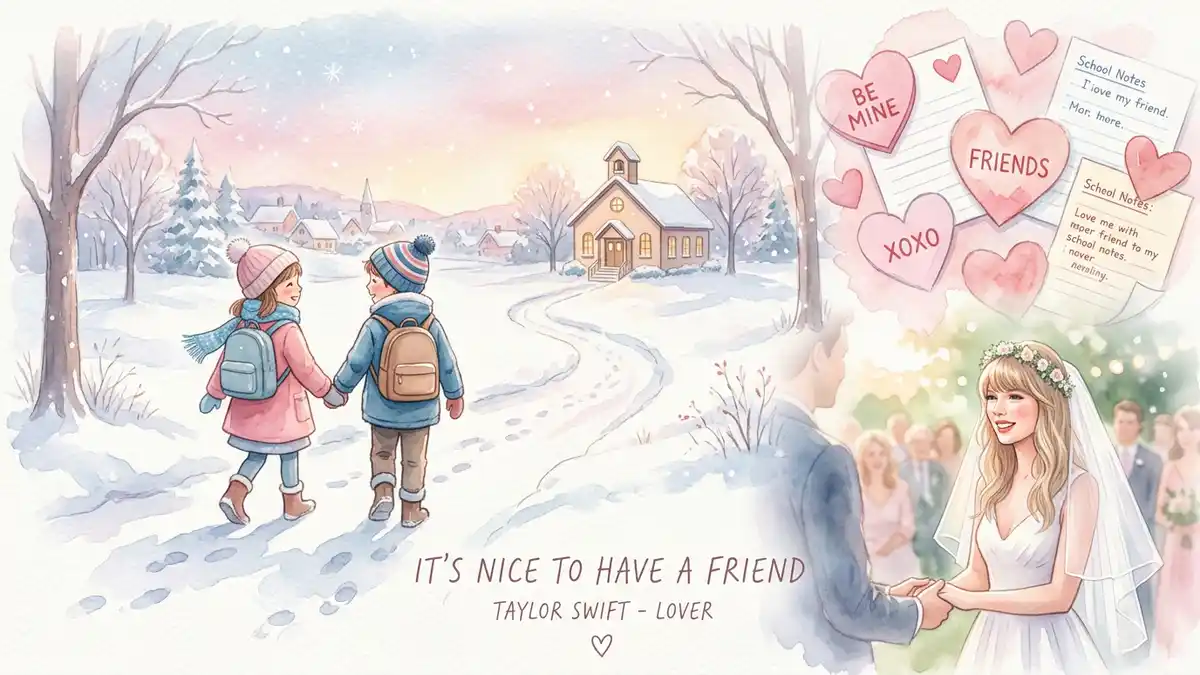

It’s Nice to Have a Friend Taylor Swift Lyrics offer one of the quietest, most patient narratives on Lover (2019), tracing a bond from childhood innocence to adult commitment without relying on a traditional pop chorus explosion. Produced by Louis Bell, Frank Dukes, and Taylor Swift—and built around delicate percussion including steel pan textures—the song feels like a short film set to music, standing apart from the album’s brighter singles while still belonging to the same romantic universe anchored by Taylor Swift’s seventh studio era.
Table of Contents
About It’s Nice to Have a Friend
Lover arrived August 23, 2019, as Swift’s first album fully owned at release—a detail fans often connect to the record’s confidence in range. “It’s Nice to Have a Friend” proves that range by choosing restraint. Where other tracks chase anthemic lift, this one lingers in small images: hallways, borrowed moments, time passing in increments you feel rather than hear shouted. The steel drums or steel pan coloring (described by listeners as central to its sonic identity) gives the arrangement a gentle, almost lullaby-like sparkle, an unusual texture in Swift’s mainstream pop catalog and a deliberate departure from guitar-driven country memory or synth-heavy confessionals.
The song is also notable for its sample-based connection: it incorporates elements derived from “Summer in the South” by the RegOrchesters, linking Swift’s narrative to a preexisting musical phrase that deepens the track’s nostalgic, cinematic quality. Sampling can function as emotional shorthand, and here it reinforces the sense of flipping through old photographs—moments you cannot fully explain to strangers but can recognize instantly in sound. That choice aligns with the lyric’s longitudinal storytelling, which needs patience more than punchlines.
Structurally, the track reads like a life arc in miniature. It begins in childhood friendship—the kind of easy proximity that adults sometimes romanticize because it predates romantic stakes—and it ends in a wedding-bell resolution that reframes the title as understatement. “It’s nice to have a friend” becomes more poignant once you realize the song argues that the best romantic partnerships can retain friendship’s gentleness: not only passion, not only drama, but steadiness. For fans who value Swift’s narrative songwriting, the song is a flex in a different register: it tells a love story without needing a villain.
Within concert culture and fan rankings, “It’s Nice to Have a Friend” often lands as a sleeper favorite—appreciated by listeners who want Lover’s full emotional spectrum, not only its most streamed singles. It is sweet without being cloying, innocent without being naive, because it acknowledges time: people change, contexts change, and love can emerge from a slow-burn familiarity rather than a lightning strike.
It’s Nice to Have a Friend Lyrics
[Verse 1]
School bell rings, walk me home
Sidewalk chalk covered in snow
Lost my gloves, you give me one
“Wanna hang out?”
“Yeah, sounds like fun”
Video games
You pass me a note
Sleeping in tents
[Chorus]
It’s nice to have a friend
It’s nice to have a friend
[Verse 2]
Light pink sky up on the roof
Sun sinks down, no curfew
20 questions, we tell the truth
You been stressed out lately? Yeah, me too
Something gave you the nerve
To touch my hand
[Chorus]
It’s nice to have a friend
It’s nice to have a friend
[Verse 3]
Church bells ring, carry me home
Rice on the ground looks like snow
Call my bluff, call you “babe”
Have my back, yeah, every day
Feels like home
Stay in bed the whole weekend
[Outro]
It’s nice to have a friend
It’s nice to have a friend
It’s nice to have a friend
Meaning and Analysis
The central interpretive claim of “It’s Nice to Have a Friend” is that friendship and romance are not opposites but phases of a continuum. The lyrics invite the listener to notice how trust can begin before desire formally names itself, and how adult love can inherit childhood kindness if both people protect it. That reading matters in Swift’s body of work because she frequently writes about love as a high-stakes drama; here, love is also a quiet privilege—something as simple, and as profound, as showing up repeatedly until years have passed.
The minimalist arrangement supports this thesis by refusing to manipulate the listener with explosive dynamics. Instead, the song asks for attention: you have to lean in, much like you lean in to hear a friend in a crowded room. The steel-pan-like timbres contribute a dreamlike innocence, almost fairy-tale, yet the narrative stays grounded in human-scale details. The contrast creates a gentle tension between memory and milestone—between the foggy sweetness of “back then” and the clarity of a commitment ceremony.
On Lover, the track also serves as tonal balance. An album famous for pastel romance and political anthems still needs breathing room; this song provides a kind of emotional hush that makes neighboring tracks hit harder. Analytically, it is a reminder that Swift’s storytelling tools include silence, spacing, and the courage to write a love song that does not sound like every other love song on the radio—proving once again that Lover was not one aesthetic but many, held together by a songwriter willing to risk variety.
FAQs
Who produced It’s Nice to Have a Friend?
The track was produced by Louis Bell, Frank Dukes, and Taylor Swift, resulting in a delicate, minimalist arrangement compared with many Lover songs.
What sample is used in It’s Nice to Have a Friend?
The song samples Summer in the South by the RegOrchesters, contributing to its nostalgic, cinematic sound.
What is It’s Nice to Have a Friend about?
The lyrics follow a story from childhood friendship into adulthood and marriage, emphasizing sweetness, patience, and understated devotion.
What instruments stand out on It’s Nice to Have a Friend?
Listeners commonly highlight steel pan or steel drum textures as a defining sonic element that sets the song apart on Lover.