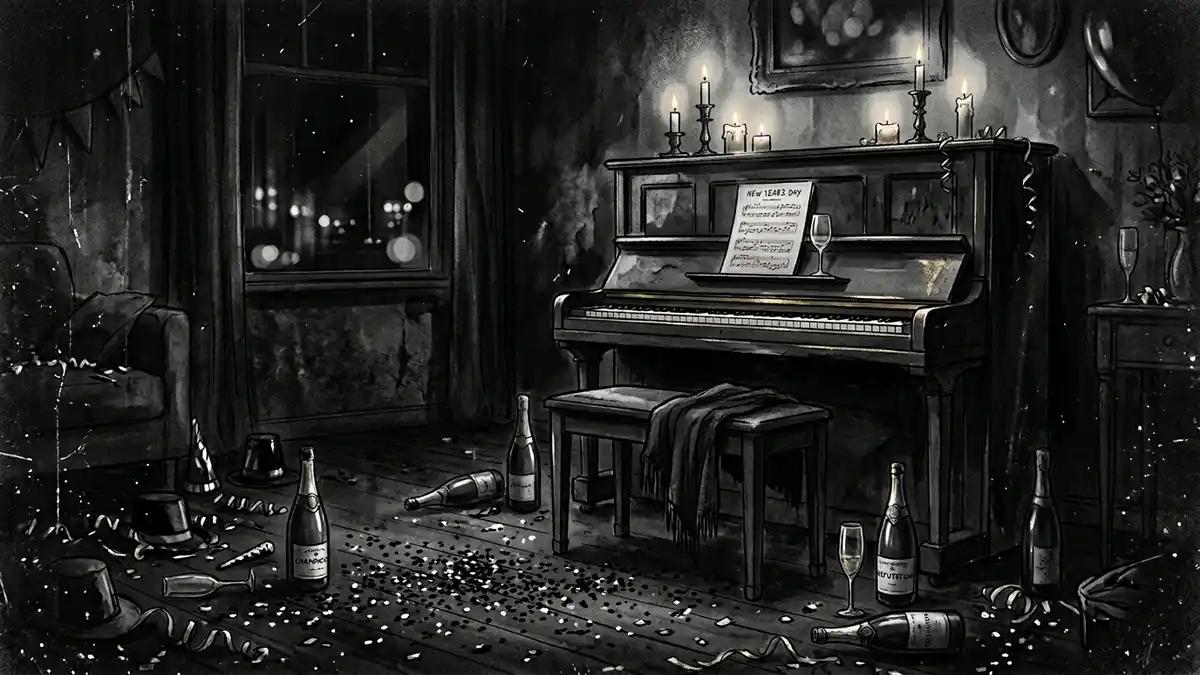

New Year’s Day Taylor Swift Lyrics close Taylor Swift’s original Reputation album with a deliberate whisper after an album-length storm of synths, bass, and celebrity mythmaking. Reputation, her sixth studio album, arrived November 10, 2017, marking a dramatic shift toward darker electropop, synth-pop, and hip-hop influences shaped by intense media scrutiny in 2016 and by key collaborators including Jack Antonoff, Max Martin, and Shellback across the project. Antonoff produced “New Year’s Day,” and the song functions as a closing thesis: after the party, after the performance, who stays to help clean up? Fans studying the 2017 tracklist—the original recording, not a Taylor’s Version re-record—often treat this finale as proof that Reputation’s heart was never only swagger. For broader timeline and discography context, visit Taylor Swift hubs that document each era.
Table of Contents
About New Year’s Day
“New Year’s Day” is a piano-driven ballad with subtle string support, a sonic palette that consciously breaks from the heavy electronic production dominating much of Reputation. Jack Antonoff’s work here is restrained: the arrangement foregrounds chord movement, vocal nuance, and space, allowing the lyrics’ domestic imagery to land without competition from aggressive kick drums or wall-of-synth textures. That stripped-back approach creates a bookend effect. If the album opens by announcing a reputation reset in thunderous pop language, it ends by returning to something closer to singer-songwriter intimacy—not identical to Swift’s country roots, but spiritually aligned with the idea that the truth often lives in small details.
Thematically, the song uses New Year’s Eve iconography as a narrative device. The holiday is culturally coded as glitter, noise, champagne, and collective performance; Swift pivots to the morning after, when floors are sticky, confetti is trash, and the crowd is gone. The message is romantic but also pragmatic: flashy devotion is easy when the lights are up; loyalty shows in mundane care. On an album preoccupied with spectacle, surveillance, and public narrative, choosing to end on a quiet promise reads as intentional artistic punctuation.
Its place as the final track gives it unusual weight in sequencing conversations. Swift could have closed with another anthemic statement; instead, she chose vulnerability and steadiness. That decision reshapes how listeners remember the album on repeat listens—the last taste is tenderness, not triumphal sneer. Critics frequently argue this finale reframes preceding songs as protective armor rather than a complete personality, suggesting the narrator’s toughness coexists with a desire for normalcy.
Public backstory around the song includes its high-profile debut on television. Swift performed “New Year’s Day” on The Tonight Show Starring Jimmy Fallon in November 2017, in an episode remembered for its emotional context following the death of Fallon’s mother. The performance became widely discussed as a gentle, heartfelt moment amid grief, and it introduced the song to a mainstream audience as Swift’s first live Reputation-era performance. Regardless of how one interprets that specific broadcast, it cemented the track’s identity as sincere balladry rather than hidden-album experiment.
New Year’s Day Lyrics
[Verse 1]
There’s glitter on the floor after the party
Girls carrying their shoes down in the lobby
Candle wax and Polaroids on the hardwood floor
You and me from the night before, but
[Chorus]
Don’t read the last page
But I stay when you’re lost, and I’m scared
And you’re turning away
I want your midnights
But I’ll be cleaning up bottles with you
On New Year’s Day
[Verse 2]
You squeeze my hand three times in the back of the taxi
I can tell that it’s gonna be a long road
I’ll be there if you’re the toast of the town, babe
Or if you strike out and you’re crawling home
[Chorus]
Don’t read the last page
But I stay when it’s hard or it’s wrong
Or we’re making mistakes
I want your midnights
But I’ll be cleaning up bottles with you
On New Year’s Day
[Bridge]
Hold on to the memories, they will hold on to you
Hold on to the memories, they will hold on to you
Hold on to the memories, they will hold on to you
And I will hold on to you
[Post-Chorus]
Please, don’t ever become a stranger
Whose laugh I could recognize anywhere
Please, don’t ever become a stranger
Whose laugh I could recognize anywhere
[Verse 3]
There’s glitter on the floor after the party
Girls carrying their shoes down in the lobby
Candle wax and Polaroids on the hardwood floor
You and me for evermore
[Chorus]
Don’t read the last page
But I stay when it’s hard or it’s wrong
Or we’re making mistakes
I want your midnights
But I’ll be cleaning up bottles with you
On New Year’s Day
[Outro]
Hold on to the memories, they will hold on to you
Hold on to the memories, they will hold on to you
Hold on to the memories, they will hold on to you
And I will hold on to you
(Hold on) Please, don’t ever become a stranger
(To the memories, they will hold on to you)
Whose laugh I could recognize anywhere
(Hold on to the memories, they will hold on to you)
Please, don’t ever become a stranger
(Hold on to the memories, they will hold on to you)
Whose laugh I could recognize anywhere
(And I will hold on to you)
Meaning and Analysis
Interpreting “New Year’s Day” starts with its central contrast between performance and permanence. Pop music loves a party chorus; this song interrogates what happens when the party ends. The lyrics ask listeners to value continuity over spectacle: folding blankets, sharing quiet jokes, doing unglamorous work together. In the context of Swift’s celebrity, that theme can be read as a statement about relationships that survive cameras, tours, and chaos—but it also works for any listener who has learned to distrust grand gestures without follow-through.
Musically, the piano ballad form signals “truth” in Western pop tradition, a convention Swift understands and deploys knowingly. After an album that plays with villain imagery and electronic masks, the simplicity of piano chords can feel like removing makeup. Yet simplicity here is not amateurism; it is clarity. Subtle strings add cinematic lift without turning the track into a show tune, preserving intimacy while still feeling finished and album-ready.
Finally, the song reinforces Reputation’s emotional thesis in a single closing image: you can reinvent your public face, you can fight back in the language of pop production, but private life still runs on small kindnesses. That idea helps the album age gracefully in fan listening habits—many people skip around for bangers, but they return to this closer when they want to feel the full arc resolve into something gentle.