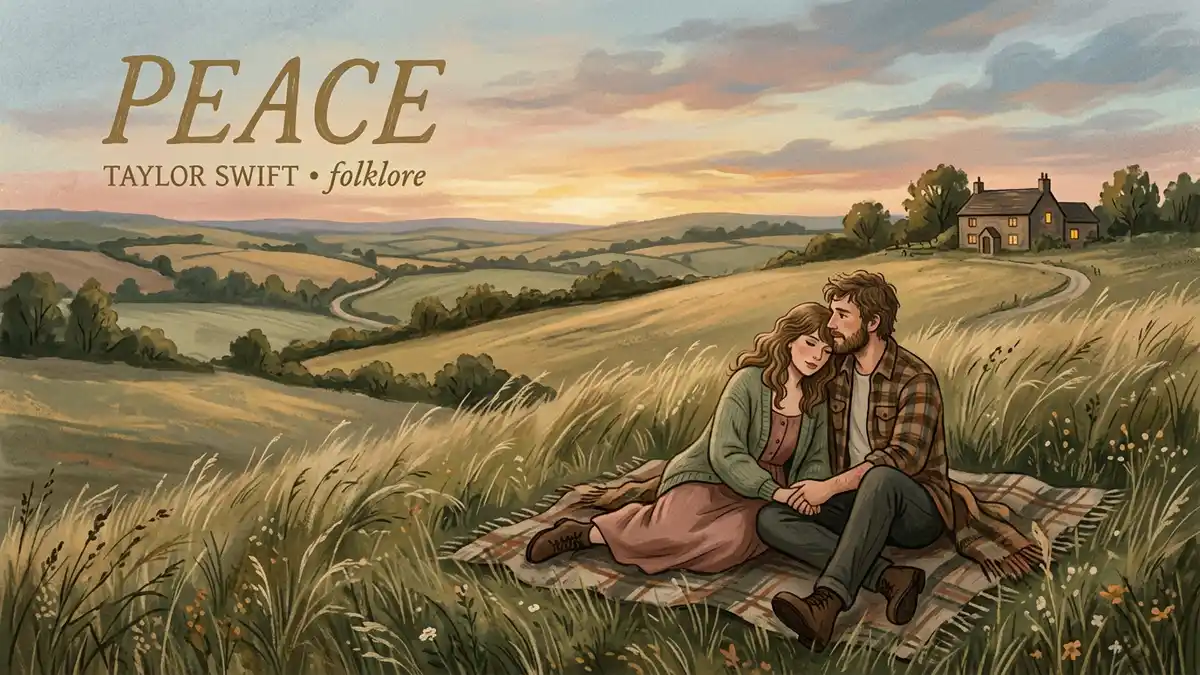

Among the sixteen tracks on Taylor Swift‘s groundbreaking 2020 album Folklore, “peace” stands out as perhaps the most nakedly autobiographical. While much of the record trades in fictional characters and imagined scenarios, the peace Taylor Swift lyrics confront a deeply personal question: can a relationship survive when one partner lives under the relentless scrutiny of global fame? Released as part of Swift’s surprise quarantine album on July 24, 2020, “peace” was written by Swift and Aaron Dessner of The National. The track’s stripped-back, intimate production — built around gentle guitar arpeggios and hushed vocals — creates a space that feels almost confessional, as though Swift is speaking directly to her partner in the quiet hours of the night when the masks of public life fall away.
About peace
“peace” is the fifteenth track on Folklore and is widely considered the most personal song on an album that largely explores fictional narratives. While Swift has not explicitly confirmed the song’s autobiographical nature in detail, the lyrics strongly suggest it is addressed to her long-term partner, British actor Joe Alwyn, whom she began dating in 2017. Their relationship was notably private by celebrity standards, with both parties making deliberate efforts to shield their lives from the media spotlight. “peace” grapples with the fundamental tension inherent in this dynamic — Swift’s awareness that no matter how hard she tries, her fame will always intrude on their shared life.
The song was written and produced by Swift and Aaron Dessner. In interviews, Dessner has described the creation of “peace” as one of the most emotionally charged sessions during the making of Folklore. The instrumental foundation is deliberately minimal — a repeating guitar figure, subtle bass, and layers of soft texture that never compete with Swift’s vocal. This restraint serves the song’s emotional purpose: there is nowhere to hide in such a sparse arrangement, and Swift’s voice carries every shade of vulnerability and uncertainty without the cushion of a full production. The result is a track that feels intensely private, as though the listener has stumbled upon a conversation never meant for outside ears.
Within the architecture of Folklore, “peace” arrives near the album’s conclusion, following a sequence of songs that explore various forms of love, loss, and longing. Its placement feels intentional — after spending an entire album examining relationships through the lens of fictional characters, Swift turns the mirror on herself and asks the most difficult question of all. The song received widespread critical acclaim, with many reviewers highlighting it as the emotional centerpiece of the album. It demonstrated that Swift’s pivot to indie folk was not merely an aesthetic choice but a vehicle for accessing a level of emotional honesty that her previous pop productions had not always permitted.
peace Lyrics
Our coming-of-age has come and gone
Suddenly this summer, it’s clear
I never had the courage of my convictions
As long as danger is near
And it’s just around the corner, darlin’
‘Cause it lives in me
No, I could never give you peace
But I’m a fire and I’ll keep your brittle heart warm
If your cascade, ocean wave blues come
All these people think love’s for show
But I would die for you in secret
The devil’s in the details, but you got a friend in me
Would it be enough if I could never give you peace?
Your integrity makes me seem small
You paint dreamscapes on the wall
I talk shit with my friends, it’s like I’m wasting your honor
And you know that I’d swing with you for the fences
Sit with you in the trenches
Give you my wild, give you a child
Give you the silence that only comes when two people understand each other
Family that I chose, now that I see your brother as my brother
Is it enough?
But there’s robbers to the east, clowns to the west
I’d give you my sunshine, give you my best
But the rain is always gonna come if you’re standin’ with me
But I’m a fire and I’ll keep your brittle heart warm
If your cascade, ocean wave blues come
All these people think love’s for show
But I would die for you in secret
The devil’s in the details, but you got a friend in me
Would it be enough if I could never give you peace?
Would it be enough if I could never give you peace?
Would it be enough if I could never give you peace?
Meaning and Analysis of peace
The central tension of “peace” is the gap between what Swift can offer her partner and what she wishes she could offer. The song is structured as a series of contrasts — she can give her love, her devotion, her wild heart, but she cannot give peace. The word “peace” functions on multiple levels throughout the song. On the surface, it refers to the literal absence of peace that comes with dating one of the most famous people on the planet: paparazzi, tabloid speculation, public scrutiny of every outing and interaction. But on a deeper level, “peace” represents the idealized version of a relationship that exists without external pressure — quiet mornings, anonymous walks, the simple luxury of being unremarkable. Swift acknowledges that this version of love is something she may never be able to provide, no matter how fiercely she protects their privacy.
What makes the song so emotionally devastating is its lack of self-pity. Swift does not blame the media or the public for the situation; she accepts it as the unavoidable cost of the life she has chosen. Instead, the song becomes an act of radical honesty — she is laying out exactly who she is and what comes with loving her, and asking whether that is enough. The line “I’d give you my sunshine, give you my best / but the rain is always gonna come if you’re standing with me” encapsulates this perfectly. It is not a complaint but a confession, delivered with the quiet gravity of someone who has spent years reckoning with the reality of their circumstances. The song asks its listener — and its subject — to make a choice with full knowledge of what that choice entails.
Dessner’s production amplifies this emotional transparency. The guitar pattern is cyclical and almost meditative, creating a sense of time suspended. There are no dramatic shifts in dynamics, no moments where the music swells to release the tension building in the lyrics. This refusal to provide catharsis is itself a statement — “peace” does not resolve its central question. Swift does not receive an answer, and the song does not pretend to offer one. It simply sits with the uncertainty, which is perhaps the most honest thing a love song can do. In an industry that thrives on grand romantic declarations, “peace” is a quiet revolution: a love song that admits love alone may not be enough, and finds a profound beauty in that admission.
FAQs about peace
Who wrote peace?
“peace” was written by Taylor Swift and Aaron Dessner. Dessner produced the track’s minimalist instrumental arrangement, while Swift wrote the lyrics and delivered the intimate vocal performance that defines the song.
What is peace about?
“peace” is a deeply personal love song about the inability to offer a partner a normal, peaceful life due to the pressures of fame. The song explores the tension between wanting to give someone everything and knowing that the chaos of celebrity will always be part of the package.
Who is peace about?
While Taylor Swift has not explicitly confirmed the subject, the song is widely believed to be about her relationship with British actor Joe Alwyn. The lyrics reflect the couple’s efforts to maintain privacy amid Swift’s global fame and the challenges that come with that dynamic.
What album is peace on?
“peace” is the fifteenth track on Taylor Swift’s eighth studio album, Folklore, which was released as a surprise album on July 24, 2020. Folklore won Album of the Year at the 63rd Grammy Awards and marked Swift’s departure from pop into indie folk and alternative music.