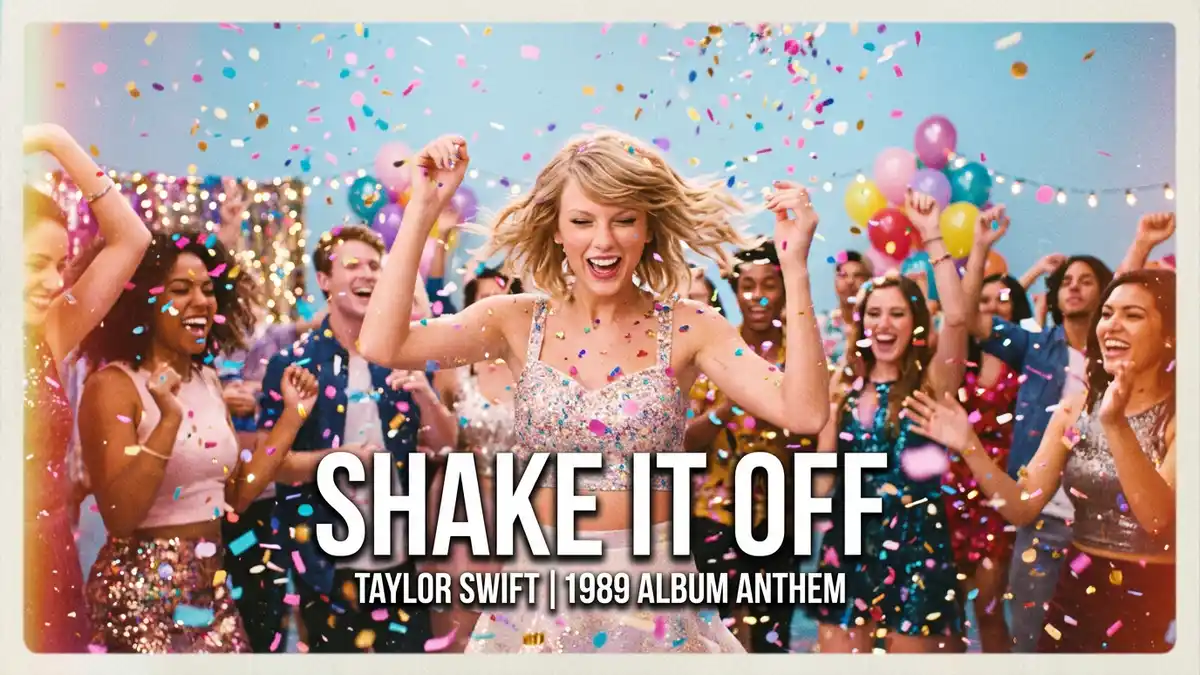

Shake It Off was the lead single from Taylor Swift’s fifth studio album, 1989, which debuted October 27, 2014 as her bold step into full-throttle pop. After years of country-tinted storytelling that still dominated radio, Swift drew a line in the sand: horns, chants, a dance-floor bounce, and a chorus designed to be shouted back at stadiums. The song is both a party track and a thesis statement—a refusal to let critics, cynics, or anonymous commenters set the tempo of her creative life.
About Shake It Off
Swift wrote Shake It Off with Max Martin and Shellback, leaning into the Swedish hitmakers’ gift for melodic repetition and instant memorability. The arrangement borrows from funk and brass-band energy, a noticeable departure from the midtempo country-pop that defined much of her earlier singles. While Jack Antonoff and Ryan Tedder contributed other flavors to 1989—Antonoff’s synth introspection, Tedder’s skyline anthems—this track is pure crowd-pleasing locomotion, engineered to introduce Swift’s pop era with maximum visibility.
Lyrically, Swift name-checks familiar criticisms: staying out too late, dating too much, dancing poorly, being “alone on Friday night.” The list format is deliberate: it mirrors the way internet chatter flattens a person into bullet points. The response is not a point-by-point rebuttal but a rhythmic shrug—shake it off—which proved divisive among critics (some called it shallow) and irresistible to audiences (streams and sales climbed fast).
As the album’s opening salvo, Shake It Off framed 1989 as playful and self-aware rather than defensive. It also set visual expectations for the era: bright colors, choreographed chaos, and Swift poking fun at her own inability to be cool in every subculture the video parodies. On the standard tracklist, it does not open the album—Welcome to New York does—but as the lead single it still functioned as many listeners’ first impression of the new sound.
For factual documentation of chart performance and release history, consult Wikipedia’s article on Shake It Off. For industry-level reporting on the single’s commercial impact, Billboard archives from 2014 provide contemporaneous chart context during Swift’s pop breakthrough.
Educators and parents sometimes adopted the chorus as a playful resilience mantra for younger listeners, which helped the song travel beyond Swift’s core demographic. At the same time, musicologists and critics debated whether its simplicity was radical honesty or calculated minimalism; either way, the debate fed the single’s visibility. In Swift’s live shows, Shake It Off routinely became a communal exhale—a moment when elaborate staging paused for pure, shouty release.
Shake It Off Lyrics
Full Shake It Off lyrics will be inserted below prior to publishing the post.
[Verse 1]
I stay out too late
Got nothin’ in my brain
That’s what people say, mm-mm
That’s what people say, mm-mm
I go on too many dates
But I can’t make ’em stay
At least that’s what people say, mm-mm
That’s what people say, mm-mm
[Pre-Chorus]
But I keep cruisin’
Can’t stop, won’t stop movin’
It’s like I got this music
In my mind sayin’, “It’s gonna be alright”
[Chorus]
‘Cause the players gonna play, play, play, play, play
And the haters gonna hate, hate, hate, hate, hate
Baby, I’m just gonna shake, shake, shake, shake, shake
I shake it off, I shake it off (ooh-ooh-ooh)
Heartbreakers gonna break, break, break, break, break
And the fakers gonna fake, fake, fake, fake, fake
Baby, I’m just gonna shake, shake, shake, shake, shake
I shake it off, I shake it off (ooh-ooh-ooh)
[Verse 2]
I never miss a beat
I’m lightnin’ on my feet
And that’s what they don’t see, mm-mm
That’s what they don’t see, mm-mm
I’m dancin’ on my own (dancin’ on my own)
I’ll make the moves up as I go (moves up as I go)
And that’s what they don’t know, mm-mm
That’s what they don’t know, mm-mm
[Bridge]
Hey, hey, hey
Just think, while you’ve been gettin’ down and out
About the liars and the dirty, dirty cheats of the world
You could’ve been gettin’ down to this sick beat
My ex-man brought his new girlfriend
She’s like, “Oh my God,” but I’m just gonna shake
And to the fella over there with the hella good hair
Won’t you come on over, baby? We can shake, shake, shake
[Final Chorus]
‘Cause the players gonna play, play, play, play, play
And the haters gonna hate, hate, hate, hate, hate (haters gonna hate)
Baby, I’m just gonna shake, shake, shake, shake, shake
I shake it off, I shake it off (ooh-ooh-ooh)
Heartbreakers gonna break, break, break, break, break (mm-mm)
And the fakers gonna fake, fake, fake, fake, fake (and fake, and fake, and fake)
Baby, I’m just gonna shake, shake, shake, shake, shake
I shake it off, I shake it off (ooh-ooh-ooh)
Meaning and Analysis
Shake It Off succeeds because it chooses rhythm over argument. Instead of explaining why the criticisms hurt, Swift builds a groove that makes dwelling feel optional. The bridge’s spoken-word-style asides—liars, dirty cheats, heart breaks—acknowledge pain without granting it the last word. That structure mirrors a coping strategy many fans recognize: you cannot control what people say, but you can sometimes control whether you dance anyway.
Critics who wanted lyrical density found the song frustrating; fans who wanted permission to stop doomscrolling found it medicinal. Pop music often works on that split. Swift’s genius here is embedding enough specificity (tabloid vocabulary, social shame, performance anxiety) inside a universal party chant that younger listeners could adopt without knowing every headline that inspired it.
The brass stabs and call-and-response vocals also nod to Motown and girl-group traditions, anchoring the track in pop history even as its production is unmistakably 2010s. That blend helped Swift bridge radio formats and age demographics during a pivotal career moment. In retrospect, the song reads as a strategic reset: if Red tested the waters of pop collaboration, Shake It Off cannonballed into the pool.
Within 1989’s emotional ecosystem, the single’s optimism is an outlier next to broodier album cuts, but that contrast matters. A record about love, fallout, and reinvention still needs oxygen; Shake It Off provides it, reminding listeners that Swift’s pop era could be silly, sweaty, and sincere all at once.
Frequently Asked Questions
Who wrote Shake It Off?
Taylor Swift wrote Shake It Off with Max Martin and Shellback, who also helped produce its upbeat pop arrangement.
What is Shake It Off about?
The song responds to public criticism and gossip by encouraging listeners to ignore negativity and keep moving, using humor and dance-floor energy as a release valve.
Was Shake It Off the first single from 1989?
Yes. Shake It Off was released as the lead single ahead of 1989’s October 27, 2014 album release, introducing Swift’s full pop sound to mainstream audiences.
What genre is Shake It Off?
It is pop with funk and brass influences, built around a chantable chorus, horns, and a four-on-the-floor dance rhythm.