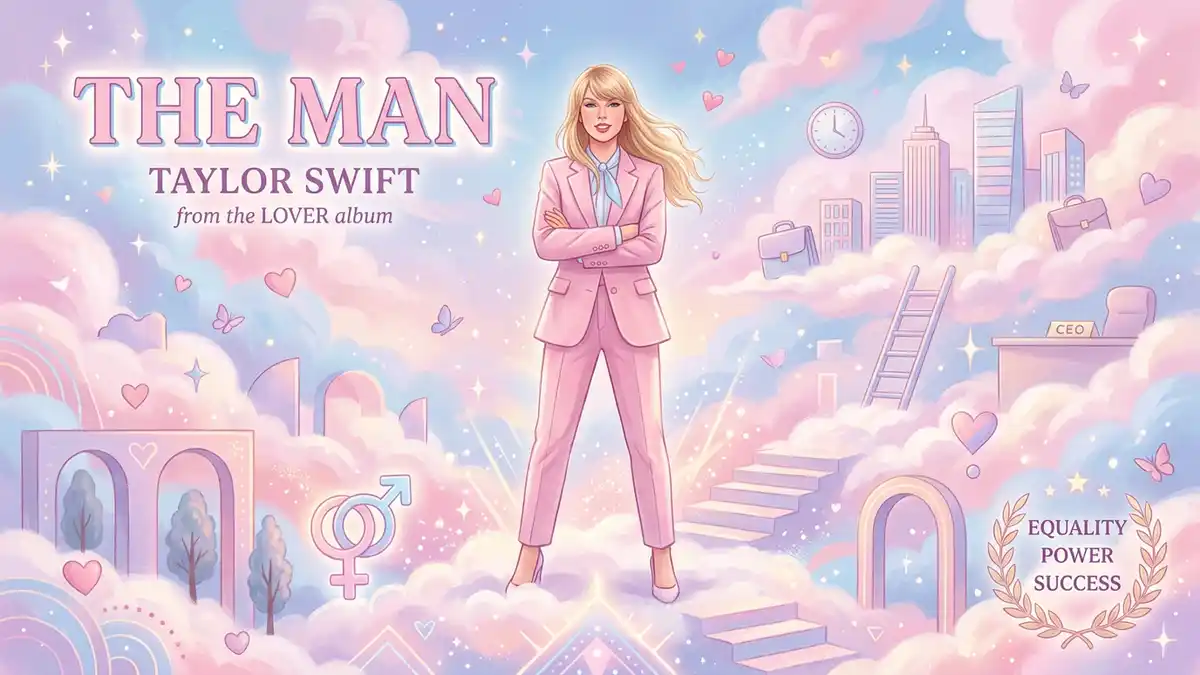

The Man Taylor Swift Lyrics power a glossy feminist pop anthem from Lover that turns industry double standards into a singalong hook—sharp, satirical, and designed to land in both headphones and headlines.
When Lover debuted August 23, 2019, Taylor Swift was publicly framing a new chapter: brighter visuals, romantic storytelling, and—crucially—ownership of her master recordings going forward on new work. “The Man” interrupts the album’s love-song flow with a different kind of intimacy: the frustration of being measured by rules that shift depending on gender.
Table of Contents
About The Man
Jack Antonoff produced “The Man,” bringing the same punchy pop sensibility he applied across much of Lover. The track’s instrumental backbone is sleek and confident—four-on-the-floor energy, earworm synth lines, a chorus that performs triumph even as the lyrics critique what society rewards in men versus punishes in women. That tension between sound and subject is part of the song’s strategy: it delivers critique as a party track, not a lecture.
Thematically, Swift targets the impossible scoring system applied to successful women in entertainment and beyond: assertiveness reframed as aggression, dating life treated as public trial, ambition read as calculation. By flipping the perspective—“I’d be just like Leo in Saint-Tropez”-style hypotheticals—the song names the invisible privilege of being presumed competent, cool, and forgiven.
As the album’s fourth single, “The Man” arrived with a music video that doubled the satire. Swift directed the clip and appeared under heavy prosthetics as a cartoonishly entitled male executive—cigar swagger, tantrums rewarded, bad behavior brushed off. The visual joke makes the thesis literal: the same actions read differently when the body performing them changes. For fans, the video became a reference point whenever conversations about sexism in pop culture resurfaced.
On Lover, the song’s placement helps diversify the album’s concerns. Not every track is a private romance; some zoom out to social observation. “The Man” insists that personal happiness and political awareness can coexist on the same record—that a project marketed with pastel romance can still make room for a barbed thesis about power.
Frank Dukes and Louis Bell contributed to other Lover tracks that skew more R&B-tinged or rhythm-forward, while Joel Little’s pop clarity appears elsewhere in the album’s DNA; “The Man” instead channels Antonoff’s stadium-ready synth pulse—an intentional choice that makes the message feel like something you hear at full volume in a car, not only read as a thread of tweets. The song’s chart performance and award-show visibility helped normalize conversations about sexism in music business coverage, even when detractors dismissed it as “on the nose.” Sometimes clarity is the point.
Educators and commentators occasionally cite the music video in discussions of gender performance, satire, and visual rhetoric—another sign of how Swift’s directing ambition expanded the song beyond audio. By embodying the exaggerated “male genius” archetype, the clip turns abstract grievance into physical comedy, then lets the laughter sting when viewers recognize the behavior from real boardrooms and comment sections.
The Man Lyrics
[Verse 1]
I would be complex, I would be cool
They’d say I played the field before I found someone to commit to
And that would be okay for me to do
Every conquest I had made would make me more of a boss to you
[Pre-Chorus]
I’d be a fearless leader
I’d be an alpha type
When everyone believes ya
What’s that like?
[Chorus]
I’m so sick of running as fast as I can
Wondering if I’d get there quicker if I was a man
And I’m so sick of them coming at me again
‘Cause if I was a man, then I’d be the man
I’d be the man
I’d be the man
[Verse 2]
They’d say I hustled, put in the work
They wouldn’t shake their heads and question how much of this I deserve
What I was wearing, if I was rude
Could all be separated from my good ideas and power moves
[Pre-Chorus]
And they would toast to me, oh, let the players play
I’d be just like Leo in Saint Tropez
[Chorus]
I’m so sick of running as fast as I can
Wondering if I’d get there quicker if I was a man
And I’m so sick of them coming at me again
‘Cause if I was a man, then I’d be the man
I’d be the man
I’d be the man
[Bridge]
What’s it like to brag about raking in dollars and getting bitches and models?
And it’s all good if you’re bad
And it’s okay if you’re mad
If I was out flashing my dollars, I’d be a bitch not a baller
They’d paint me out to be bad
So, it’s okay that I’m mad
[Outro]
I’m so sick of running as fast as I can
Wondering if I’d get there quicker if I was a man (you know that)
And I’m so sick of them coming at me again (coming at me again)
‘Cause if I was a man (if I was a man)
Then I’d be the man (then I’d be the man)
I’m so sick of running as fast as I can (as fast as I can)
Wondering if I’d get there quicker if I was a man (hey)
And I’m so sick of them coming at me again (coming at me again)
‘Cause if I was a man (if I was a man), then I’d be the man
I’d be the man
I’d be the man (oh)
I’d be the man (yeah)
I’d be the man (I’d be the man)
If I was a man, then I’d be the man
Meaning and Analysis
Analytically, “The Man” works because it pairs specificity with universality. Listeners who never stepped on a stadium stage still recognize workplace parallels: who gets called “difficult,” who gets called “a boss,” whose confidence is celebrated versus policed. Swift’s examples skew toward celebrity life—headlines, yachts, boardrooms—but the underlying mechanism is portable.
The production choice to make the track euphoric rather than bitter matters. A snarling acoustic protest song would signal one mood; a danceable pop single signals another—anger converted into fuel, critique designed to spread. That approach aligns with Lover’s broader pop ambition: big melodies, clean hooks, messages that can travel through radio formatting.
In Swift’s larger catalog, “The Man” sits alongside other songs that address public narrative and gendered expectations, but its directness is unusually blunt. It names the game instead of only hinting through metaphor—an artistic decision that reads as confidence in the audience’s literacy about media sexism by 2019.
FAQs
Who produced “The Man”?
Jack Antonoff produced The Man, a feminist pop anthem from Taylor Swift’s 2019 album Lover.
Did Taylor Swift direct “The Man” music video?
Yes. Swift directed the video and appeared as a male character in prosthetics to satirize double standards in business and entertainment.
What is “The Man” about?
The song critiques gendered double standards—how men are praised for traits and behaviors women are punished for, especially in the public eye.
Was “The Man” a single?
The Man was released as the fourth single from Lover and became one of the album’s most discussed commentary tracks.