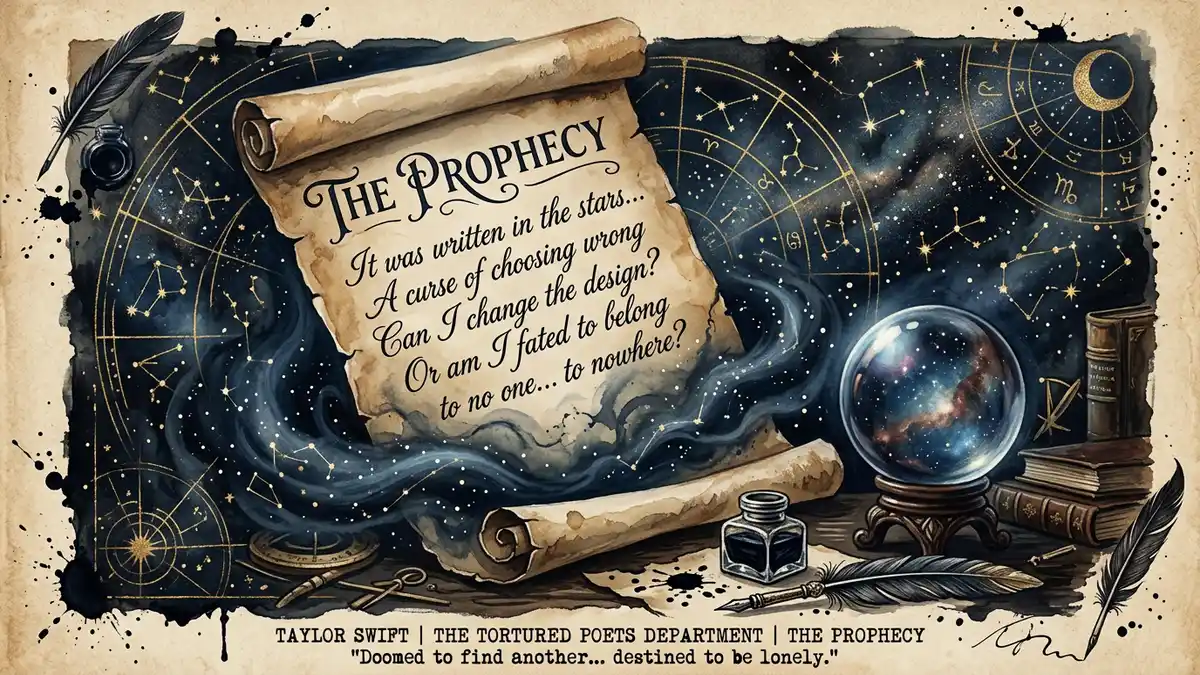

Fans tracing The Prophecy Taylor Swift lyrics are often struck by how urgently the song asks fate for a rewrite—less a love ballad than a prayer shouted into a storm. This guide situates the track within The Tortured Poets Department, its Anthology placement, and the production choices that make its despair feel cinematic. For more context on Swift’s career, visit Taylor Swift.
Table of Contents
About The Prophecy
The Prophecy is Anthology track 26 on The Tortured Poets Department, Swift’s 2024 project structured as a double album. The first sixteen tracks comprise the core album; tracks seventeen through thirty-one form The Anthology, a surprise companion set released the same day—April 19, 2024. As a late Anthology piece, The Prophecy deepens the album’s existential streak, asking whether emotional outcomes are chosen, earned, or simply assigned.
The song is a product of Swift’s collaboration with Aaron Dessner, who co-produces alongside her on multiple Tortured Poets tracks while Jack Antonoff helms much of the rest. Dessner’s touch is audible in the song’s patient build, reverberant textures, and vocal intimacy—sound design that feels like standing in a cathedral made of weather, appropriate for lyrics that address the universe as if it were a stubborn authority.
Thematically, The Prophecy revolves around loneliness, destiny, and the hunger for a different future. The narrator imagines life as something foretold—an outcome whispered before she had a chance to object—and pleads for an alternate ending that includes softness, partnership, and peace. It is one of the album’s most spiritually raw moments, less about a specific ex than about the fear of being cosmically mismatched with happiness.
Within The Anthology, the track sits near other songs that wrestle with reputation, truth, and self-definition. Its title suggests myth and inevitability, echoing Swift’s long-standing fascination with folklore and fate—from cardigan metaphors to clock imagery—while updating that language for a mid-career artist reflecting on what success cannot automatically solve.
The Prophecy Lyrics
Hand on the throttle, thought I caught lightning in a bottle
Oh, but it’s gone again
And it was written, I got cursed like Eve got bitten
Oh, was it punishment?
Pad around when I get home, I guess a lesser woman would’ve lost hope
A greater woman wouldn’t beg, but I looked to the sky and said
Please, I’ve been on my knees, change the prophecy
Don’t want money, just someone who wants my company
Let it once be me, who do I have to speak to
About if they can redo the prophecy?
Cards on the table, mine play out like fools in a fable
Oh, it was sinking in (sinking in) (aah)
Slow is the quicksand, poison blood from the wound of the pricked hand
Oh, still I dream of him
Please, I’ve been on my knees, change the prophecy
Don’t want money, just someone who wants my company
Let it once be me, who do I have to speak to
About if they can redo the prophecy?
And I sound like an infant, feelin’ like the very last drops of an ink pen
A greater woman stays cool, but I howl like a wolf at the Moon
And I look unstable, gathered with a coven ’round a sorceress’ table
A greater woman has faith, but even statues crumble if they’re made to wait
I’m so afraid I sealed my fate, no sign of soulmates
I’m just a paperweight in shades of greige
Spendin’ my last coin so someone will tell me
It’ll be okay
Ooh, ooh
Ooh, ooh
Please, I’ve been on my knees, change the prophecy
Don’t want money, just someone who wants my company
Let it once be me, who do I have to speak to
About if they can redo the prophecy?
Who do I have to speak to to change the prophecy?
Hand on the throttle, thought I caught lightning in a bottle
Oh, but it’s gone again
Pad around when I get home, I guess a lesser woman would’ve lost hope
A greater woman wouldn’t beg, but I looked to the sky and said
Please
Meaning and Analysis
The Prophecy treats unhappiness as a sentence. Swift’s language borrows from superstition and storytelling: destinies, omens, bargains, and appeals to higher powers. The emotional engine is not melodrama for its own sake but the exhaustion of someone who has done the work, told the truth, survived the noise—and still wonders why comfort feels withheld.
The production supports this reading by refusing cheap uplift. Instead of a triumphant final chorus, the song lingers in tension, as if the narrator is still mid-conversation with fate. That choice makes the track feel honest about depression’s circular thinking: hope and despair can alternate within the same breath, especially when you begin to believe the worst outcomes are “meant” for you.
Read alongside Swift’s broader catalog, The Prophecy complements songs about performance, scrutiny, and emotional labor. Fame can look like fulfillment from the outside while feeling like isolation on the inside; a “prophecy” can be the story the public tells about you until you almost believe it. The lyrics invite empathy for anyone who has ever asked, quietly or loudly, for their luck to change.
As Anthology track 26 on the April 19, 2024 double album, the song sits inside a deliberate structure: the first sixteen tracks form The Tortured Poets Department proper, while tracks 17–31 expand the world as The Anthology. Aaron Dessner’s co-production with Swift helps the song feel like a midnight prayer caught on tape—distinct from the neon pulse that Jack Antonoff often supplies elsewhere on the project—without breaking the album’s unified mood of searching, confessing, and rewriting the past.
Fans searching specifically for The Prophecy Taylor Swift lyrics are often trying to name a feeling that is hard to admit in daylight: the suspicion that love is something other people receive on schedule, while you are left negotiating with fate like an unfair teacher. The song refuses to tidy that suspicion into a slogan; instead it lets the question stay open, which is part of its emotional honesty.
FAQs
What album is The Prophecy on?
The Prophecy is Anthology track 26 on The Tortured Poets Department (2024), part of The Anthology bonus tracks released April 19, 2024.
Who produced The Prophecy?
Aaron Dessner co-produced with Taylor Swift, contributing to the atmospheric, introspective sound of the song.
What is The Prophecy about?
The song is a plea for love and happiness in the face of loneliness and a sense of predetermined fate—the narrator hopes the future can differ from what was foretold.
Is The Prophecy a main-track or bonus song?
It is a bonus track from The Anthology (tracks 17–31), not one of the first sixteen songs on the album.