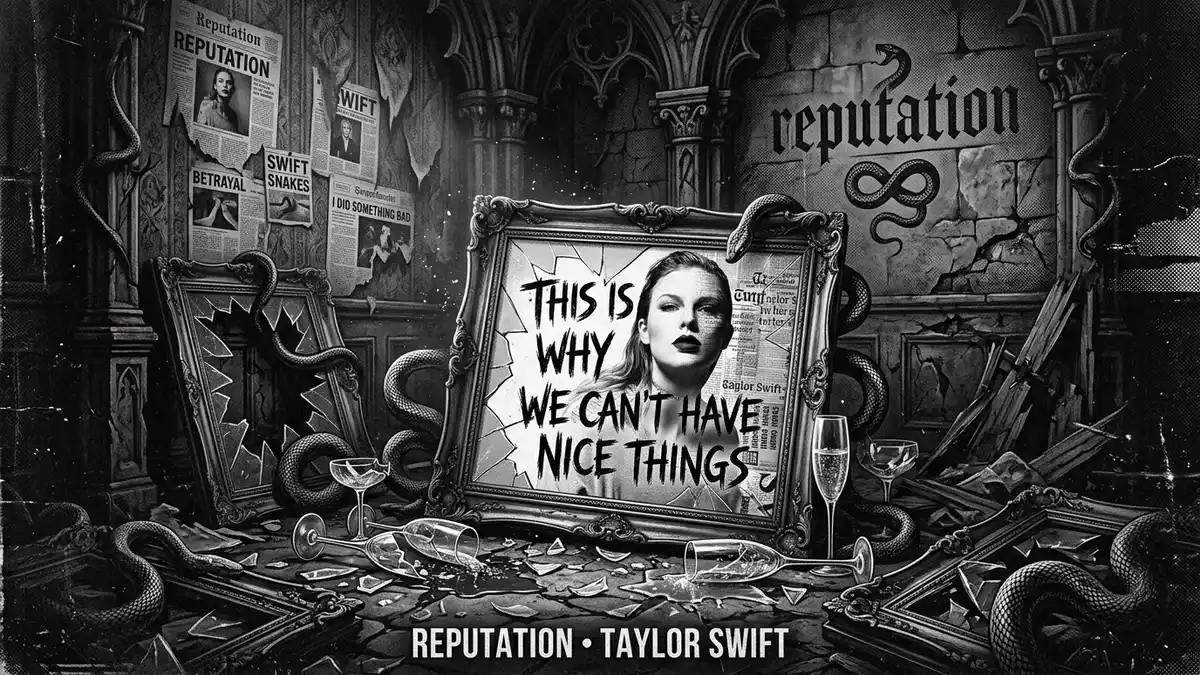

This Is Why We Can’t Have Nice Things Taylor Swift Lyrics capture one of Reputation’s most theatrical, sarcastic peaks: a bright pop anthem that sounds like a champagne toast until you listen closely to the bitterness bubbling underneath. Released November 10, 2017, Taylor Swift’s sixth studio album arrived after a period of intense public scrutiny in 2016, and much of the record channels that pressure into darker electropop, synth-pop, and hip-hop-influenced production. Jack Antonoff produced this track, and his knack for combining melodic shine with emotional bite matches the song’s tongue-in-cheek storytelling. Readers exploring Swift’s original Reputation era—distinct from any future re-recording project—often start with this song when discussing celebrity feuds, broken trust, and the performance of forgiveness. Context on Swift’s career arcs is available via Taylor Swift resources that map albums to their cultural moments.
Table of Contents
About This Is Why We Can’t Have Nice Things
“This Is Why We Can’t Have Nice Things” is built like a party song with a poisoned invitation. Antonoff’s production leans into a bold, almost celebratory pop bounce: big piano chords, propulsive rhythm, and a sing-song quality that invites audience participation. That cheerfulness is the joke. The lyrics tell a different story—one about generosity being exploited, friendship curdling into spectacle, and the exhaustion of trying to share joy with someone who treats your trust as content. The widely circulated interpretation connects the narrative to the collapse of Swift’s public relationship with Kanye West after years of headline-grabbing incidents; Swift has not needed to confirm every fan theory for the song to function as a cultural Rorschach test about betrayal in the spotlight.
The track’s most famous structural choice is its spoken bridge about forgiveness, which then breaks into laughter. That moment is deliberately destabilizing: it mimics the language of maturity and closure while refusing to perform sincerity. In concert, the bit often becomes a communal release—fans shout along, laugh on cue, and treat the break as a cathartic wink. Whether you read it as genuine amusement, defensive humor, or a staged punchline, it is unmistakably theatrical, aligning with Reputation’s broader interest in persona, masks, and controlled narrative.
On the album, the song reinforces Swift’s mid-to-late-record strategy of mixing confrontation with dark comedy. Reputation is not only a “vengeance album” caricature; it is also a carefully sequenced pop statement. Placing a sarcastic anthem like this among sleeker romance tracks and brooding electropop cuts prevents the listener from settling into one emotional temperature. The Jack Antonoff production also bridges Swift’s pop maximalism with indie-influenced texture choices, so the song feels expensive and slightly manic at the same time—like glitter scattered over a burned bridge.
Behind the scenes, the song’s creation fits the album’s collaborative ecosystem: Swift writing with sharp pop instincts, Antonoff shaping sonic drama, and the final mix prioritizing clarity so every sarcastic line lands. The title phrase itself was already a meme-level cultural shorthand for ruined fun, which Swift repurposes as both punchline and thesis. That intertextuality—borrowing a common internet-family-joke expression for a stadium-pop setting—is part of why the track instantly read as “of its moment” in 2017, even as its themes of loyalty and public humiliation remain perennial in celebrity discourse.
This Is Why We Can’t Have Nice Things Lyrics
[Verse 1]
It was so nice throwing big parties
Jump into the pool from the balcony
Everyone swimming in a champagne sea
And there are no rules when you show up here
Bass beat rattling the chandelier
Feeling so Gatsby for that whole year
So why’d you have to rain on my parade?
I’m shaking my head, I’m locking the gates
[Chorus]
This is why we can’t have nice things, darling
Because you break them, I had to take them away
This is why we can’t have nice things, honey (oh)
Did you think I wouldn’t hear all the things you said about me?
This is why we can’t have nice things
[Verse 2]
It was so nice being friends again
There I was giving you a second chance
But you stabbed me in the back while shaking my hand
And therein lies the issue, friends don’t try to trick you
Get you on the phone and mind-twist you
And so I took an axe to a mended fence
But I’m not the only friend you’ve lost lately (mmm-mmm)
If only you weren’t so shady
[Chorus]
This is why we can’t have nice things, darling
Because you break them, I had to take them away
This is why we can’t have nice (nice things) things (baby), honey (oh)
Did you think I wouldn’t hear all the things you said about me?
This is why we can’t have-
[Bridge]
Here’s a toast to my real friends
They don’t care about the he said, she said
And here’s to my baby
He ain’t reading what they call me lately
And here’s to my mama
Had to listen to all this drama
And here’s to you
‘Cause forgiveness is a nice thing to do
Hahaha, I can’t even say it with a straight face!
[Outro]
This is why we can’t have nice things, darling (darling)
Because you break them, I had to take them away
This is why we can’t have nice (uh-uh) things (oh no), honey (baby, oh)
Did you think I wouldn’t hear all the things you said about me?
This is why we can’t have nice things, darling (oh)
And here’s to my real friends (Oh) because you break them, I had to take them
And here’s to my baby (Oh) nice things, honey
They didn’t care about the he said, she said
Did you think I wouldn’t hear all the things you said about me?
This is why we can’t have nice things
Meaning and Analysis
Meaning in “This Is Why We Can’t Have Nice Things” operates on two tracks simultaneously: narrative specifics and general emotional truth. On the narrative level, Swift sketches a former closeness that included private hospitality and shared celebration, then describes betrayal and performative reconciliation attempts. On the general level, almost anyone can map the pattern onto workplace two-facedness, friendship groups splintering, or online dynamics where private trust becomes public entertainment. The song’s power is that it refuses to be only one of those readings; the pop sheen welcomes casual listeners while the details reward closer attention.
The forgiveness bridge plus laughter is a masterclass in tonal irony. Pop music often resolves conflict with earnest uplift; Swift chooses messy human reaction instead. Laughter can signal genuine amusement, nervous relief, or cruelty, and the ambiguity keeps the song from becoming a simple morality tale. In the context of Reputation, it also aligns with the album’s recurring question: when the world demands you perform grace on demand, what happens if you decline the script? The answer here is not pretty, but it is compelling.
Finally, the track illustrates how Swift uses genre contrast as meaning. A song this bitter could have been a minor-key ballad; making it a bright, stomping anthem turns pain into spectacle on Swift’s own terms. That choice mirrors the album’s larger project: reclaiming the narrative volume turned against her and redirecting it toward choreographed, deliberate pop theater.