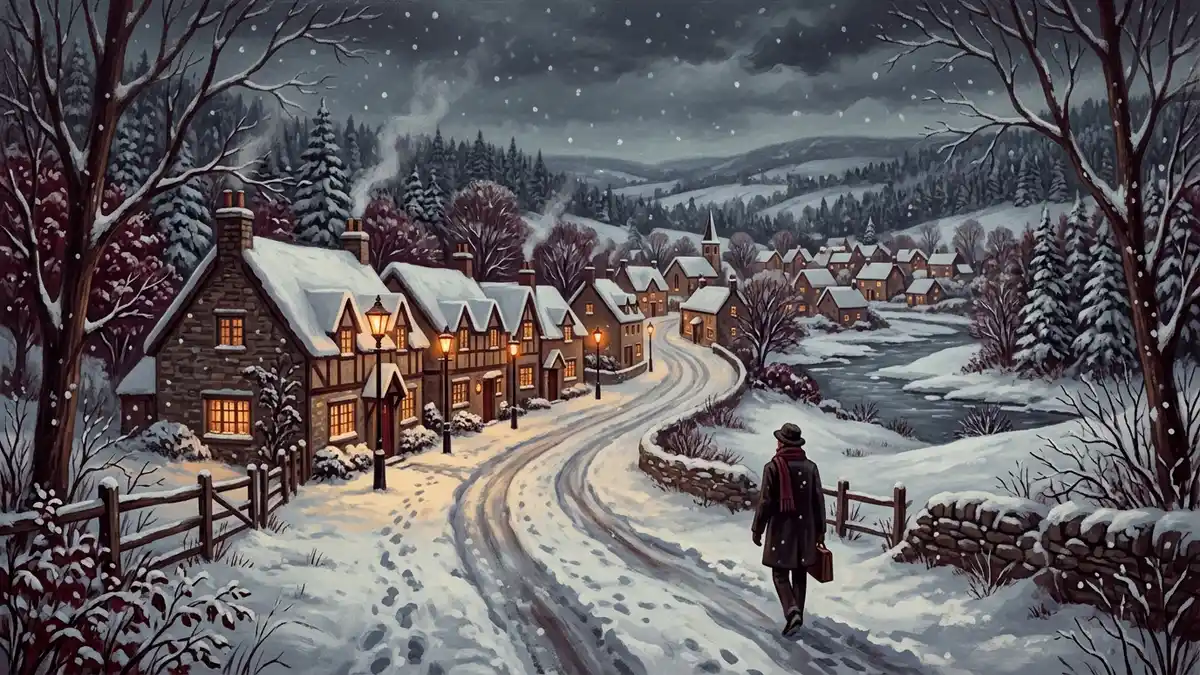

People searching for ‘Tis the Damn Season Taylor Swift lyrics are usually chasing a very specific kind of bittersweet: the holiday return home, the old flame flickering back to life, and the knowledge that the clock is running out. The song appears on Evermore, Taylor Swift’s ninth studio album, released December 11, 2020. Like its sister album Folklore, Evermore was developed with Aaron Dessner, Jack Antonoff, and Swift, weaving indie folk, alternative rock, and chamber pop into a wintery songbook of complicated adults making complicated choices.
This track is especially beloved for how it captures temporary intimacy—two people slipping into old rhythms because the season makes the past feel close. If you want a wider lens on Swift’s biography and discography, explore our main guide to Taylor Swift. This page covers the song’s background, a lyrics placeholder for publishing, thematic analysis, and frequently asked questions.
About ‘Tis the Damn Season
“’Tis the Damn Season” is track four on Evermore and a quintessential Aaron Dessner collaboration in mood and architecture: grounded instrumentation, cinematic detail, and a narrator who sounds like she is recounting a private film only she can fully explain. The premise is deceptively simple—coming back to your hometown for the holidays and rekindling something with someone who still fits like a worn-in coat—but Swift’s writing loads the scenario with class cues, road imagery, and the emotional math of what you can afford to pretend for a few days.
One of the song’s most compelling contexts on the album is its relationship to “Dorothea,” another Evermore track that many listeners read as the other side of the same story. Whether you treat that connection as explicit canon or as a thematic rhyme, the pairing enriches both songs: one voice anchored in the small-town world, another voice arriving from a life elsewhere, each carrying longing shaped by different constraints. “’Tis the Damn Season” thrives in that dual perspective energy, even when the lyrics stay in a single first-person lane.
Nostalgia here is not sanitized. Swift emphasizes the seduction of the familiar—shared history, easy laughter, the shorthand of old romance—while also implying the limits of that familiarity. The season itself becomes a kind of permission structure: you can do things in December that you would not promise in January. That temporal trap gives the song its ache; it is beautiful because it is temporary, and devastating for the same reason.
‘Tis the Damn Season Lyrics
If I wanted to know who you were hanging with
While I was gone, I would’ve asked you
It’s the kind of cold fogs up windshield glass
But I felt it when I passed you
There’s an ache in you put there by the ache in me
But if it’s all the same to you
It’s the same to me
So we could call it even
You could call me babe for the weekend
‘Tis the damn season, write this down
I’m stayin’ at my parents’ house
And the road not taken looks real good now
And it always leads to you and my hometown
I parked my car right between the Methodist
And the school that used to be ours
The holidays linger like bad perfume
You can run, but only so far
I escaped it too, remember how you watched me leave
But if it’s okay with you
It’s okay with me
We could call it even
You could call me babe for the weekend
‘Tis the damn season, write this down
I’m stayin’ at my parents’ house
And the road not taken looks real good now
Time flies, messy as the mud on your truck tires
Now I’m missing your smile, hear me out
We could just ride around
And the road not taken looks real good now
And it always leads to you and my hometown
Sleep in half the day just for old times’ sake
I won’t ask you to wait if you don’t ask me to stay
So I’ll go back to LA and the so-called friends
Who’ll write books about me, if I ever make it
And wonder about the only soul who can tell which smiles I’m fakin’
And the heart I know I’m breakin’ is my own
To leave the warmest bed I’ve ever known
We could call it even
Even though I’m leavin’
And I’ll be yours for the weekend
‘Tis the damn season
We could call it even
You could call me babe for the weekend
‘Tis the damn season, write this down
I’m stayin’ at my parents’ house
And the road not taken looks real good now
Time flies, messy as the mud on your truck tires
Now I’m missing your smile, hear me out
We could just ride around
And the road not taken looks real good now
And it always leads to you and my hometown
It always leads to you and my hometown
Meaning and Analysis
On a thematic level, “’Tis the Damn Season” is about the gravitational pull of the past when you cross a geographic threshold. Returning home can feel like stepping into a former self, and an old lover can become a mirror for that self—comforting, dangerous, and strangely honest. Swift’s narrator often sounds clear-eyed about the arrangement: this is not necessarily a forever plan, but a seasonally bounded escape from the person she has become elsewhere.
The lyrics gain power from social texture: who has “made it out,” who stayed, what success looks like from different vantage points, and how desire interacts with envy and pride. Rather than presenting hometown romance as pure sweetness, Swift lets class and ambition hum beneath the surface. That subtlety prevents the song from being only a cozy holiday ballad; it is also a negotiation between two lives that diverged for reasons that cannot be undone in a single week.
Musically, the restrained production supports a cinematic reading. The storytelling feels like scenes—car windows, quiet streets, conversations that skip exposition because both people already know the backstory. The emotional climax is not necessarily a dramatic confrontation; it is the realization that some reunions are rituals you repeat because they hurt in a familiar way. That brand of bittersweet is a hallmark of Swift’s Evermore storytelling: adulthood as a series of choices with no clean winners.
Frequently Asked Questions
What album is “‘Tis the Damn Season” on?
The song is on Taylor Swift’s ninth studio album, Evermore, released December 11, 2020. It is track four.
Who produced “‘Tis the Damn Season”?
Aaron Dessner produced “‘Tis the Damn Season,” aligning with the song’s indie folk storytelling style and atmospheric instrumentation on Evermore.
How does “‘Tis the Damn Season” connect to “Dorothea”?
Many listeners interpret the two songs as complementary perspectives within the same narrative world, with “Dorothea” echoing the other side of a small-town relationship and “‘Tis the Damn Season” focusing on a holiday homecoming reunion.
What is the song’s main theme?
It explores nostalgic, bittersweet reconnection during a hometown holiday visit—temporary intimacy, old flames, and the tension between past comfort and present reality.