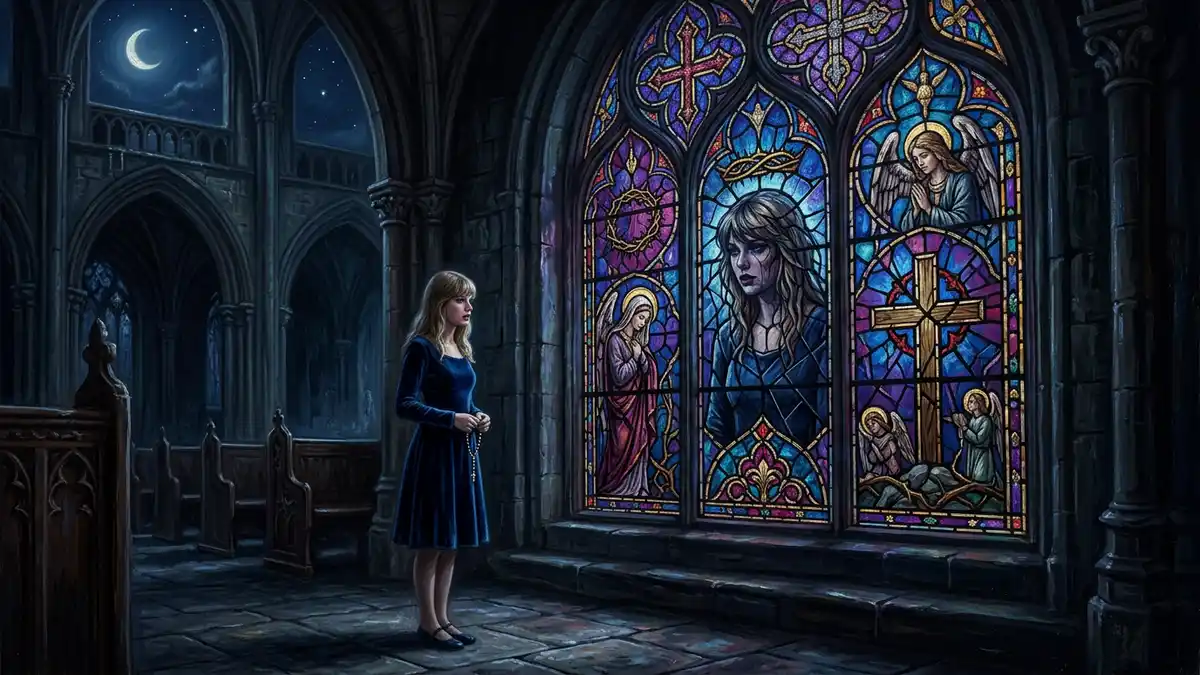

Would’ve, Could’ve, Should’ve Taylor Swift lyrics are among the most discussed words in the entire Midnights era—sharp, spiritual, and devastating in their clarity. The song appears as a 3am Edition bonus track and immediately earned a reputation for emotional intensity, with fans drawing parallels to earlier heartbreak epics in Swift’s catalog. If you are reading for meaning as much as melody, this track rewards close attention to its imagery, its timeline, and the way it turns regret into something almost hymnlike.
Table of Contents
About Would’ve, Could’ve, Should’ve
Would’ve, Could’ve, Should’ve is Track 19 on the 3am Edition of Midnights, Taylor Swift’s tenth studio album, released October 21, 2022. While Midnights is often described as an album about sleepless thoughts and self-examination, this song pushes further into the territory of moral reckoning: it is less about a single bad night and more about a chapter of life that still echoes. The writing credit alongside Aaron Dessner signals a different sonic world than some of Swift’s pure synth-pop cuts—more atmospheric, more bruised, and more willing to sit in discomfort.
Dessner’s collaborations with Swift have frequently produced songs that feel like intimate confessionals wrapped in organic instrumentation and moody harmonic movement. Here, that chemistry supports a lyric sheet that many listeners read as a spiritual sequel to “Dear John,” the famously detailed breakup track from Swift’s earlier work. Whether or not you connect the song to any specific real-life narrative, the public conversation around it has often centered on age, power dynamics, and the painful clarity that can arrive years after a relationship ends.
The title phrase itself—would’ve, could’ve, should’ve—signals counterfactual thinking, the kind of spiral that happens when you rewrite the past from a safer distance. In that sense, the song fits neatly into Midnights as a whole: it is music for the hours when your brain refuses to let a memory stay buried. What makes this track distinctive is how explicitly it uses religious imagery and language of innocence and loss, elevating personal regret into something that sounds almost like liturgy. Fans often describe listening as emotionally exhausting in the best way—like holding still while a storm passes through the speakers.
Because Midnights arrived with multiple editions and bonus chapters, songs like this one also shaped how audiences understood the album’s scope. The standard edition introduced a tightly curated midnight concept; the 3am tracks widened the aperture, proving that Swift was willing to release some of her most raw material as part of the same era rather than saving it indefinitely. In online discussions, Would’ve, Could’ve, Should’ve is frequently cited as a centerpiece of that expanded story—a song people return to when they want lyrics that feel uncomfortably honest.
Would’ve, Could’ve, Should’ve Lyrics
If you would’ve blinked, then I would’ve
Looked away at the first glance
If you tasted poison, you could’ve
Spit me out at the first chance
And if I was some paint, did it splatter
On a promising grown man?
And if I was a child, did it matter
If you got to wash your hands?
Oh, all I used to do was pray
Would’ve, could’ve, should’ve
If you’d never looked my way
I would’ve stayed on my knees
And I damn sure never would’ve danced with the devil
At nineteen
And the God’s honest truth is that the pain was heaven
And now that I’m grown, I’m scared of ghosts
Memories feel like weapons
And now that I know, I wish you’d left me wondering
If you never touched me, I would’ve
Gone along with the righteous
If I never blushed, then they could’ve
Never whispered about this
And if you never saved me from boredom
I could’ve gone on as I was
But, Lord, you made me feel important
And then you tried to erase us
Oh, you’re a crisis of my faith
Would’ve, could’ve, should’ve
If I’d only played it safe
I would’ve stayed on my knees
And I damn sure never would’ve danced with the devil
At nineteen
And the God’s honest truth is that the pain was heaven
And now that I’m grown, I’m scared of ghosts
Memories feel like weapons
And now that I know, I wish you’d left me wondering
God rest my soul
I miss who I used to be
The tomb won’t close
Stained glass windows in my mind
I regret you all the time
I can’t let this go
I fight with you in my sleep
The wound won’t close
I keep on waiting for a sign
I regret you all the time
If clarity’s in death, then why won’t this die?
Years of tearing down our banners, you and I
Living for the thrill of hitting you where it hurts
Give me back my girlhood, it was mine first
And I damn sure never would’ve danced with the devil
At nineteen
And the God’s honest truth is that the pain was heaven
And now that I’m grown, I’m scared of ghosts
Memories feel like weapons
And now that I know, I wish you’d left me wondering
God rest my soul
I miss who I used to be
The tomb won’t close
Stained glass windows in my mind
I regret you all the time
I can’t let this go
I fight with you in my sleep
The wound won’t close
I keep on waiting for a sign
I regret you all the time
Oh, God, rest my soul
I miss who I used to be
The tomb won’t close
Stained glass windows in my mind
I regret you all the time
I can’t let this go
I fight with you in my sleep
The wound won’t close
I keep on waiting for a sign
I regret you all the time
Meaning and Analysis
Interpreting Would’ve, Could’ve, Should’ve usually begins with its tone: the song does not ask for sympathy for a fictional character—it presents a speaker who is wrestling with guilt, anger, and the sickening clarity of hindsight. Religious references can function as more than ornament; they can frame the relationship as something that the speaker now sees as morally complicated, even sacrilegious, depending on how you read individual lines in full context. That approach makes the song feel different from a straightforward breakup track; it is closer to a reckoning.
The John Mayer association in fan discourse is widespread because listeners often connect lyrical clues, vocal performance, and Swift’s established history of addressing past relationships through song. It is important to treat any real-life mapping as interpretation rather than confirmed fact unless explicitly stated by the artist. Still, the cultural conversation is part of why the song mattered so immediately: it gave fans language for discussing power, age gaps, and emotional consequences without reducing the art to a headline.
Musically, the Dessner-Swift lane tends to privilege tension over release, and that choice supports the lyrics. Where a big cathartic pop chorus might offer easy comfort, a song like this often keeps the listener slightly off-balance, mirroring intrusive thoughts that refuse neat closure. In the landscape of Midnights, that makes Would’ve, Could’ve, Should’ve a defining example of how the album’s “late night” theme can include moral insomnia—not just missing someone, but confronting who you were when you loved them.