
If you are searching for The Black Dog Taylor Swift lyrics, you are stepping into one of The Anthology’s most location-haunted heartbreak songs—track 17 of the expanded The Tortured Poets Department release from April 19, 2024. Named after a London pub, the track turns a real place into a symbol for knowing too much about someone who has moved on. For general Swift context and updates, visit Taylor Swift.
Table of Contents
About The Black Dog
The Black Dog opens the surprise second half of Taylor Swift’s 2024 double release: The Anthology, comprising tracks 17–31 that arrived the same day as the standard sixteen-song album. While the first disc is often discussed as The Tortured Poets Department “proper,” Swift explicitly framed the project as a two-part body of work—sixteen songs plus fifteen additional chapters—expanding the album’s emotional and narrative scope in one night. The Black Dog sits at track 17, making it many listeners’ first step past the original endpoint and into a darker corridor of memory.
Co-produced with Aaron Dessner, the song fits the Dessner wing of Swift’s catalog: intimate, textured, and willing to linger in uncomfortable emotional weather. Where Antonoff-driven tracks sometimes sparkle even when lyrics ache, Dessner collaborations often feel like rooms with dim lamps—details emerge slowly, then stay. That sonic personality suits a lyric concerned with surveillance of the heart: seeing an ex’s movements (or imagining them), picturing them in a familiar venue, and feeling the double pain of loss plus unwanted knowledge.
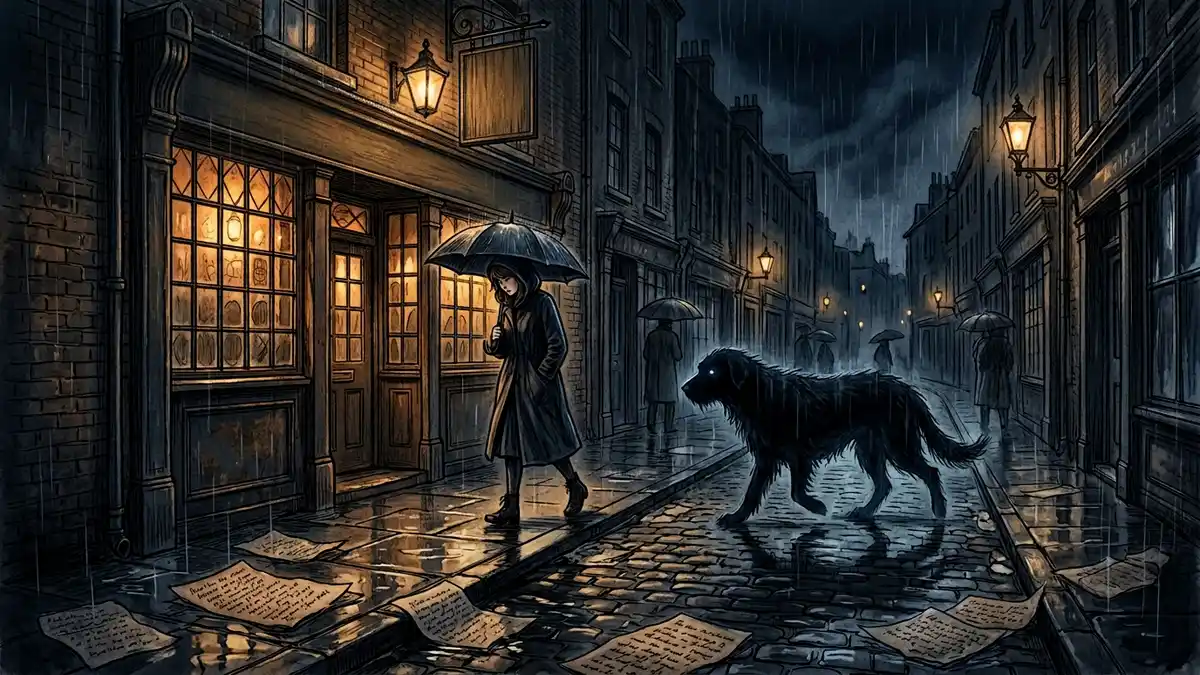
The title’s pub reference became a cultural footnote almost immediately after release: fans and travelers sought out the real Black Dog location in London, turning a lyric into a pilgrimage site. Whether or not you chase geography, the song’s core idea travels: modern breakups often leave digital breadcrumbs—locations tagged, photos posted, mutual friends’ stories—so grief can come with coordinates. Swift compresses that reality into a single haunting image: not just “they moved on,” but “they moved on somewhere I can name.”
As the first Anthology track, The Black Dog signals that the “bonus” material is not an afterthought; it is an extension of the album’s central questions about memory, narrative control, and the cruelty of clarity. It also reframes what track 16 accomplished as an ending: closure on the standard edition is not closure in life—there is always another chapter, another bar, another song queued after the credits.
The Black Dog Lyrics
I am someone who until recent events
You shared your secrets with
And your location, you forgot to turn it off
And so I watch as you walk
Into some bar called The Black Dog
And pierce new holes in my heart
You forgot to turn it off
And it hits me
I just don’t understand
How you don’t miss me in The Black Dog
When someone plays The Starting Line
And you jump up, but she’s too young to know this song
That was intertwined in the magic fabric of our dreaming
Old habits die screaming
I move through the world with a heart broken
My longing state unspoken
And I may never open up the way I did for you
And all of those best laid plans
You said I needed a brave man
Then proceeded to play him
Until I believed it too
And it kills me
I just don’t understand
How you don’t miss me in the shower
And remember how my rain-soaked body was shakin’
Do you hate me?
Was it hazing for a cruel fraternity?
I pledged and I still mean it
Old habits die screaming
Six weeks of breathin’ clean air
I still miss the smoke
Were you makin’ fun of me
With some esoteric joke?
Now I wanna sell my house
And set fire to all my clothes
And hire a priest to come and exorcise my demons
Even if I die screaming
And I hope you hear it
And I hope it’s shitty in The Black Dog
When someone plays The Starting Line
And you jump up, but she’s too young to know this song
That was intertwined in the tragic fabric of our dreaming
‘Cause tail between your legs, you’re leavin’
I still can’t believe it
‘Cause old habits die screaming
Meaning and Analysis
People looking up The Black Dog Taylor Swift lyrics frequently fixate on the intersection of place and pain. A pub name is concrete; heartbreak is abstract. Swift binds them so the listener can’t separate the wound from the map. The result is a song about emotional self-sabotage via information: you cannot un-know where someone is happy without you. In a pre-digital world, distance could pretend to be ignorance; now, ignorance takes effort, and effort can feel like dignity—or like obsession, depending on the hour.
Dessner’s production supports this claustrophobia with pacing that refuses cheap release. The song doesn’t necessarily “build to triumph”; it builds to recognition. That choice aligns with The Anthology’s role as a space for Swift to explore tones that might feel too heavy—or too specific—to place earlier in the tracklist. Here, specificity is the point: heartbreak songs often generalize to universalize; Swift sometimes universalizes by naming the exact bar.
Culturally, the track also demonstrates how Swift’s music reshapes real-world spaces—fans turning a lyric into a landmark, tourism following narrative. That phenomenon isn’t trivial; it shows how songs become social objects, shared maps, collective memory. The Black Dog therefore works on two levels: a private story of post-breakup ache, and a public demonstration of fandom’s power to assign meaning to places—sometimes lovingly, sometimes uncomfortably.
FAQs
What is “The Black Dog” named after?
The title references a pub name in London; after release, the location drew increased attention from fans and tourists.
Is “The Black Dog” on the main 16-track album?
No—it is track 17, the first song on The Anthology bonus portion (tracks 17–31) released the same day as the standard edition.
Who produced “The Black Dog”?
Aaron Dessner co-produced the track, bringing a more atmospheric, organic production style.
What is the song about thematically?
It explores the pain of knowing an ex has moved on, including imagery tied to tracking location or picturing them in a specific real-world setting.