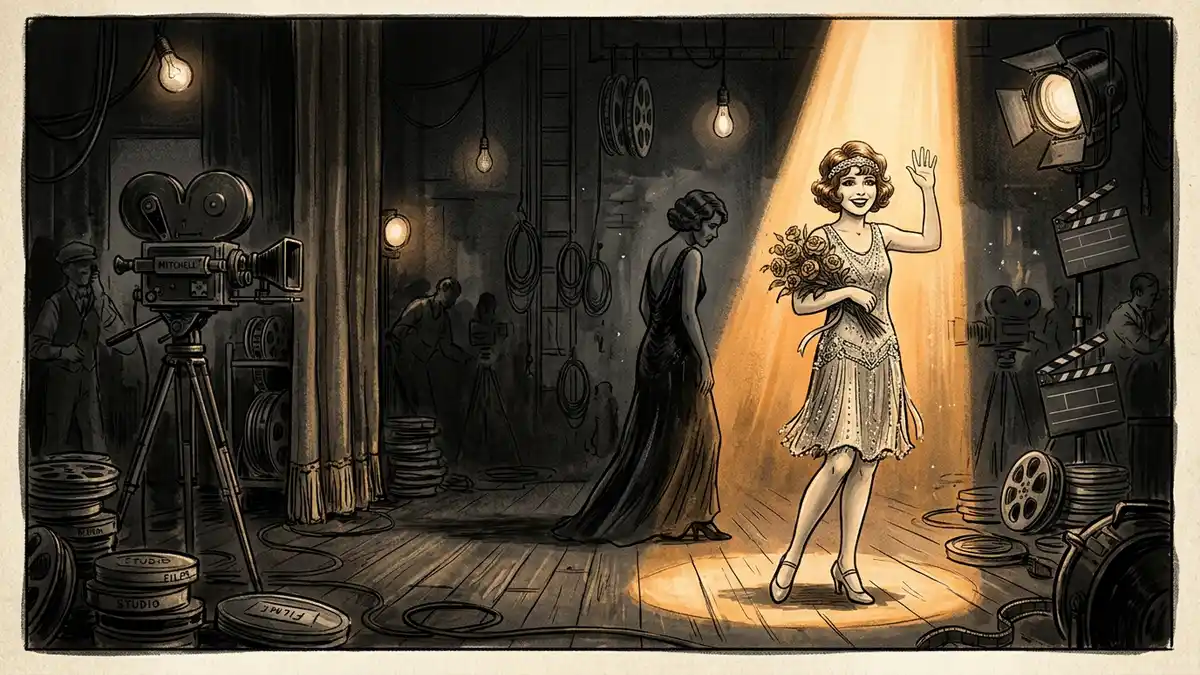

Readers looking for Clara Bow Taylor Swift lyrics are often drawn to the standard edition’s closing statement on The Tortured Poets Department—a song that links Hollywood history, mythmaking, and the modern celebrity machine. Released April 19, 2024, as track 16, it ends the first disc’s sixteen-song arc before the project continues into The Anthology. For broader Swift coverage, start with Taylor Swift on the home portal.
Table of Contents
About Clara Bow
Clara Bow is the final track on the standard sixteen-song edition of The Tortured Poets Department, the “main” album released April 19, 2024, before Swift expanded the project the same night with The Anthology (tracks 17–31). Produced by Taylor Swift and Jack Antonoff, the song uses historical and musical reference points to explore how fame treats women: how it flatters, consumes, replaces, and forgets—often while insisting it is only celebrating. Naming the track after Clara Bow, the silent-film-era “It Girl,” signals Swift’s intent to connect past and present machinery of stardom.
The song’s narrative strategy is comparative: Bow becomes a mirror, then Stevie Nicks enters the lyric as another emblem of a woman whose artistry became public property. By the time Swift’s own name appears in the frame—handled carefully, without turning the song into a lecture—the listener understands the project: this is not mere name-dropping, but a lineage of women who were told they were special and then punished for being too visible, too human, or too enduring.
Production-wise, Antonoff’s palette gives the track a cinematic lift—moments that feel like closing credits, others like a spotlight narrowing to a single face. As a finale to the standard edition, Clara Bow refuses a simplistic “happy ending,” because the industry story it tells is cyclical. Instead, it offers something more like wisdom hardened into melody: a recognition that the machine learns new costumes but repeats old patterns.
Placed at track 16, the song also reshapes how listeners remember the album’s first half. Everything that came before—heartbreak, humor, anger, performance, renewal—now gets reframed as material the world will try to narrate for Swift, just as it narrated women before her. The track therefore functions as both ending and warning: the poet may close the book, but the public will open a new one without asking.
Clara Bow Lyrics
You look like Clara Bow
In this light, remarkable
All your life, did you know
You’d be picked like a rose?
I’m not trying to exaggerate
But I think I might die if it happened
Die if it happened to me
No one in my small town thought I’d see the lights of Manhattan
This town is fake, but you’re the real thing
Breath of fresh air through smoke rings
Take the glory, give everything
Promise to be dazzling
You look like Stevie Nicks
In ’75, the hair and lips
Crowd goes wild at her fingertips
Half moonshine, a full eclipse
I’m not trying to exaggerate
But I think I might die if I made it
Die if I made it
No one in my small town thought I’d meet these suits in LA
They all wanna say
This town is fake, but you’re the real thing
Breath of fresh air through smoke rings
Take the glory, give everything
Promise to be dazzling
The crown is stained, but you’re the real queen
Flesh and blood amongst war machines
You’re the new God we’re worshipping
Promise to be dazzling
Beauty is a beast that roars down on all fours
Demanding more
Only when your girlish glow flickers just so
Do they let you know?
It’s hell on earth to be heavenly
Them’s the breaks, they don’t come gently
You look like Taylor Swift
In this light, we’re lovin’ it
You’ve got edge, she never did
The future’s bright, dazzling
Meaning and Analysis
When fans search Clara Bow Taylor Swift lyrics, they are often trying to unpack how Swift uses historical figures as shorthand for systemic pressure. Clara Bow represents early Hollywood’s appetite for a new face—a woman reduced to an archetype (“It”) while her interior life disappears behind headlines. Swift’s songwriting asks a blunt question: how much has actually changed when the medium is faster and the audience is global? The song suggests continuity: admiration and cruelty still arrive as a package deal.
Including Stevie Nicks deepens the argument by bridging film and music industries. Nicks is not a silent-era prop; she is a living legend—yet legends, too, become symbols people fight over. Swift’s work here is meta without being cold: she is writing as someone who knows the cost of being read as a character instead of a person. The lyric’s power is that it refuses a single villain; the villain is often the pattern—an entertainment economy that needs heroines it can later sacrifice for narrative spice.
Read alongside The Tortured Poets Department’s themes of writing and reputation, Clara Bow becomes a thesis track: poetry may be personal, but publication makes it communal property. The standard edition ends here, and the listener is implicitly handed off to The Anthology—more songs, more angles—mirroring the endless scroll of public storytelling Swift critiques. The ending is not “closure,” it is a door: the album continues, and so does the world’s appetite.
FAQs
Who was Clara Bow?
Clara Bow was a major silent-film-era star often associated with the “It Girl” phenomenon—fame as a blend of charisma, publicity, and intense public scrutiny.
Why is the song named “Clara Bow”?
Swift uses Bow as a historical reference point to discuss cycles of fame, image-making, and how the industry treats women in the spotlight.
Is “Clara Bow” the last song on the standard album?
Yes—it is track 16, the final track of the main sixteen-song edition; additional songs appear on The Anthology portion of the release.
Who produced “Clara Bow”?
Taylor Swift and Jack Antonoff produced the track.