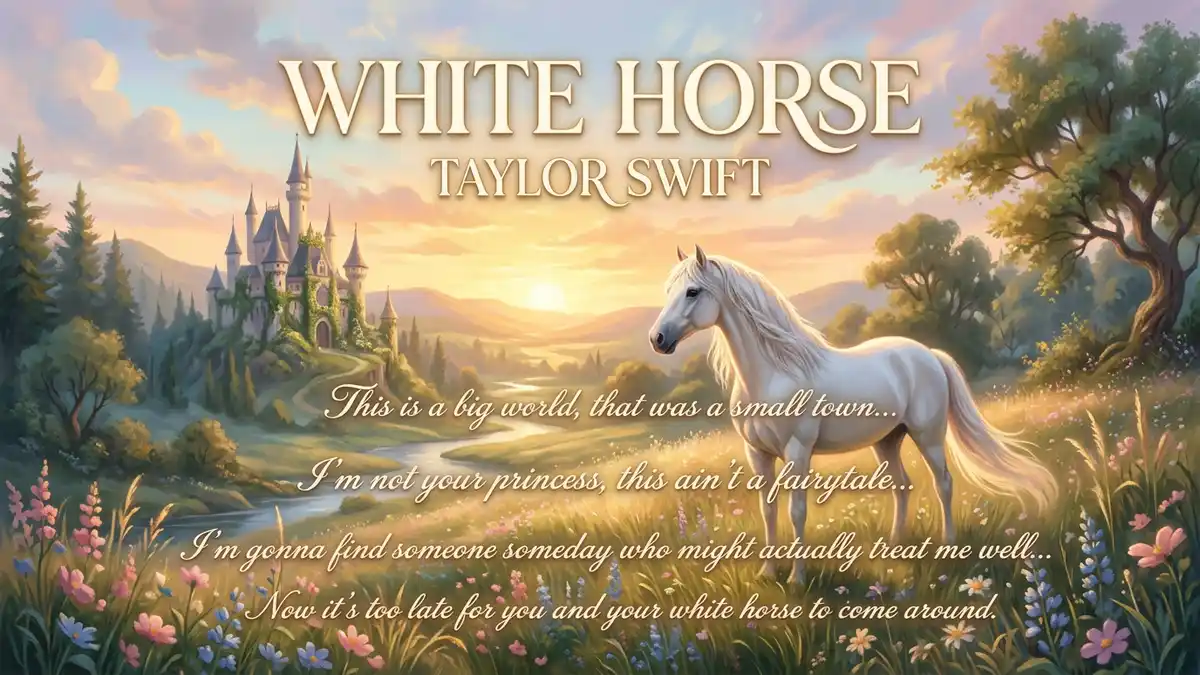

“White Horse” Taylor Swift lyrics are from the album Fearless (2008), Taylor Swift‘s second studio album. This Grammy-winning ballad marks a turning point in Swift’s songwriting, replacing fairy-tale fantasies with raw disillusionment as the narrator realizes her relationship is not the storybook romance she imagined. Below you’ll find the complete lyrics, meaning, and analysis of “White Horse.”
Table of Contents
About “White Horse” by Taylor Swift
“White Horse” is a country pop ballad co-written by Taylor Swift and Liz Rose, and produced by Swift and Nathan Chapman. It was released as the second single from Fearless on December 8, 2008, through Big Machine Records. The track runs three minutes and 54 seconds and is built around a delicate finger-picked guitar melody, accented with piano and cello to create a somber, understated atmosphere that sets it apart from the album’s more upbeat tracks.
Swift wrote the song about the moment of realization that a relationship is not what you thought it was — the painful instant when the fairy-tale illusion shatters. The song uses fairy-tale imagery of princesses, stairwells, and white horses as metaphors for romantic idealism, then systematically dismantles each one. Swift has spoken about how the song represented an emotional evolution in her songwriting, moving from the wide-eyed hopefulness of her debut album into more nuanced, bittersweet territory. The track notably gained early exposure when it was featured in a 2008 episode of the television series Grey’s Anatomy, introducing Swift’s music to a broader audience.
Commercially and critically, “White Horse” was a significant achievement. It peaked at number 13 on the Billboard Hot 100 and reached number two on the Hot Country Songs chart. The RIAA certified it double platinum. At the 2010 Grammy Awards, the song won two awards: Best Country Song and Best Female Country Vocal Performance, cementing Swift’s reputation as one of the finest songwriters of her generation. The music video, directed by Trey Fanjoy, premiered on February 7, 2009, on CMT and became the first video ever to debut at number one on the network’s countdown show. Swift later re-recorded the track for Fearless (Taylor’s Version) in 2021.
White Horse Lyrics
[Verse 1]
Say you’re sorry
That face of an angel
Comes out just when you need it to
As I paced back and forth all this time
‘Cause I honestly believed in you
Holding on
The days drag on
Stupid girl
I should have known, I should have known
[Chorus]
That I’m not a princess, this ain’t a fairy tale
I’m not the one you’ll sweep off her feet
Lead her up the stairwell
This ain’t Hollywood, this is a small town
I was a dreamer before you went and let me down
Now it’s too late for you
And your white horse, to come around
[Verse 2]
Maybe I was naive,
Got lost in your eyes
And never really had a chance
My mistake I didn’t know to be in love
You had to fight to have the upper hand
I had so many dreams
About you and me
Happy endings
Now I know
[Chorus]
I’m not a princess, this ain’t a fairy tale
I’m not the one you’ll sweep off her feet
Lead her up the stairwell
This ain’t Hollywood, this is a small town
I was a dreamer before you went and let me down
Now it’s too late for you
And your white horse, to come around
[Bridge]
And there you are on your knees
Begging for forgiveness, begging for me
Just like I always wanted but I’m so sorry
[Final Chorus]
‘Cause I’m not your princess, this ain’t a fairytale
I’m gonna find someone someday who might actually treat me well
This is a big world, that was a small town
There in my rear view mirror disappearing now
And it’s too late for you and your white horse
Now it’s too late for you and your white horse, to catch me now
[Outro]
Oh, whoa, whoa, whoa
Try and catch me now
Oh, it’s too late
To catch me now
Meaning and Analysis of “White Horse”
“White Horse” is a song about the death of romantic idealism, and it stands as one of the most emotionally mature tracks on the Fearless album. While songs like “Love Story” and the title track celebrate the exhilarating possibilities of love, “White Horse” confronts what happens when those fantasies collide with reality. The narrator has believed in the fairy tale — the prince, the stairwell, the grand romantic gestures — and now must reckon with the fact that none of it was real. The repeated declaration “I’m not a princess, this ain’t a fairy tale” is not self-pity but self-awareness, a hard-won recognition that real life rarely follows the script.
The song’s most striking literary device is the systematic deconstruction of fairy-tale tropes. Each element of the classic romance narrative is named and then denied: the princess, the fairy tale, the sweeping off feet, the stairwell, Hollywood. By listing these archetypes and rejecting them one by one, Swift creates a sense of accumulating loss — not just of the relationship, but of the worldview that made it seem possible. The contrast between “this ain’t Hollywood, this is a small town” grounds the fantasy in unglamorous reality, and the line “I was a dreamer before you went and let me down” ties the personal betrayal to a larger loss of innocence.
The bridge and final chorus mark a powerful emotional shift. When the narrator describes her ex “on your knees, begging for forgiveness, begging for me — just like I always wanted,” she acknowledges that she is getting exactly what she once dreamed of, yet it no longer matters. This is the song’s most devastating insight: that trust, once broken, cannot be restored even by the grand gesture that was once so desired. The final chorus transforms the small town from a prison into something disappearing in the rear-view mirror, as the narrator reclaims her agency. The shift from “this is a small town” to “this is a big world” signals growth, freedom, and the beginning of a new chapter.
FAQs
Who wrote “White Horse” by Taylor Swift?
“White Horse” was co-written by Taylor Swift and Liz Rose, and produced by Swift and Nathan Chapman.
What awards did “White Horse” win?
The song won two Grammy Awards in 2010: Best Country Song and Best Female Country Vocal Performance.
Was “White Horse” featured on television?
Yes, the song was featured in a 2008 episode of Grey’s Anatomy, which helped introduce Swift’s music to a wider audience.
What is the meaning of “White Horse” by Taylor Swift?
The song is about the painful realization that a relationship is not the fairy-tale romance the narrator imagined, and finding the strength to walk away.