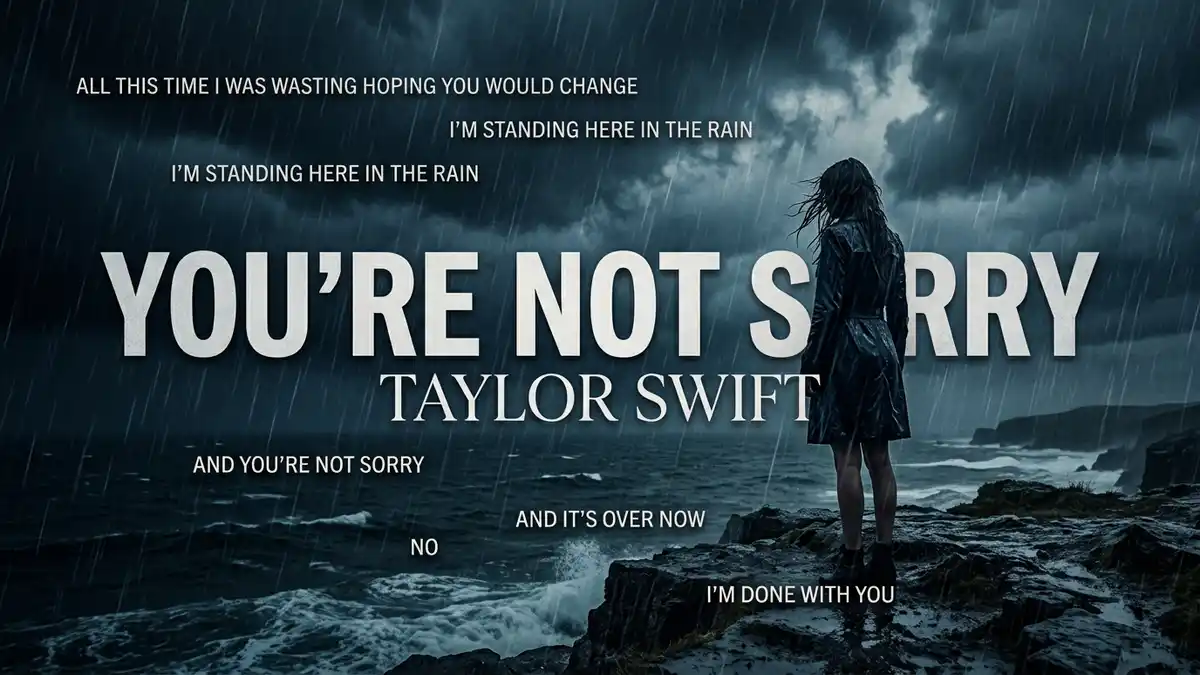

“You’re Not Sorry” Taylor Swift lyrics are from the album Fearless (2008), Taylor Swift‘s second studio album. This powerful rock-tinged ballad captures the moment of clarity when someone finally sees through an ex’s empty apologies and decides to walk away for good. Below you’ll find the complete lyrics, meaning, and analysis of “You’re Not Sorry.”
Table of Contents
About “You’re Not Sorry” by Taylor Swift
“You’re Not Sorry” was written solely by Taylor Swift and produced by Swift alongside Nathan Chapman. The song stands as one of the few tracks on Fearless that Swift wrote entirely on her own, without a co-writer. She has described the song as being about “this guy who turned out to not be who I thought he was,” explaining that she wrote it when she reached “the breaking point” of being hurt repeatedly by someone who offered hollow apologies. The deeply personal nature of the songwriting gives the track an unmistakable authenticity.
Musically, “You’re Not Sorry” is a rock power ballad that begins with delicate piano and fiddle in the verses before building to dramatic, crescendoing electric guitars in the refrains. This dynamic contrast between quiet vulnerability and explosive defiance perfectly mirrors the emotional journey of the lyrics — from hurt to empowerment. The song was released as a promotional single on October 28, 2008, ahead of the full album release, and it charted at number 11 on both the US Billboard Hot 100 and the Canadian Hot 100. The RIAA certified it platinum.
The song gained additional exposure through its connection to television. An electronic remix of “You’re Not Sorry” was created for an episode of CSI: Crime Scene Investigation in which Swift made a guest appearance. She also performed the track at the 44th Academy of Country Music Awards in 2009 and included it in the setlists for both the Fearless Tour and the Speak Now World Tour. A re-recorded version, “You’re Not Sorry (Taylor’s Version),” was released on the 2021 album Fearless (Taylor’s Version).
You’re Not Sorry Lyrics
[Verse 1]
All this time I was wasting
Hoping you would come around
I’ve been giving out chances every time
And all you do is let me down
And it’s taking me this long
Baby but I figured you out
And you’re thinking we’ll be fine again
But not this time around
[Chorus]
You don’t have to call anymore
I won’t pick up the phone
This is the last straw
Don’t wanna hurt anymore
And you can tell me that you’re sorry
But I don’t believe you baby
Like I did before
You’re not sorry, no no, no no
[Verse 2]
Looking so innocent
I might believe you if I didn’t know
Could’ve loved you all my life
If you hadn’t left me waiting in the cold
And you got your share of secrets
And I’m tired of being last to know
And now you’re asking me to listen
‘Cause it’s worked each time before
[Chorus]
But you don’t have to call anymore
I won’t pick up the phone
This is the last straw
Don’t wanna hurt anymore
And you can tell me that you’re sorry
But I don’t believe you baby
Like I did before
You’re not sorry, no no
You’re not sorry, no no
[Bridge]
You had me crawling for you honey
And it never would’ve gone away, no
You used to shine so bright
But I watched all of it fade
[Final Chorus]
You don’t have to call anymore
I won’t pick up the phone
This is the last straw
There’s nothing left to beg for
And you can tell me that you’re sorry
But I don’t believe you baby
Like I did before
You’re not sorry
No, no, no
You’re not sorry, no no
Meaning and Analysis of “You’re Not Sorry”
“You’re Not Sorry” captures a pivotal emotional moment — the instant when patience runs out and a pattern of deceit finally becomes clear. The narrator has spent the relationship giving second chances and believing apologies, but the opening lines signal that the cycle is ending: “It’s taking me this long, baby but I figured you out.” The word “figured” is key — it implies a revelation, a puzzle finally solved, transforming the narrator from a hopeful believer into someone armed with painful clarity. The line “you’re thinking we’ll be fine again, but not this time around” delivers the verdict with quiet finality.
The chorus functions as both a declaration and a boundary. “You don’t have to call anymore / I won’t pick up the phone” is a concrete, actionable statement of independence — not just an emotional outburst but a decision. The phrase “this is the last straw” grounds the song in the accumulation of disappointments rather than a single event, making it relatable to anyone who has endured a pattern of broken promises. The subtle evolution in the final chorus — where “don’t wanna hurt anymore” shifts to “there’s nothing left to beg for” — shows the narrator moving from self-protection to total emotional detachment.
The bridge offers a brief but powerful flashback: “You used to shine so bright, but I watched all of it fade.” This is one of Swift’s most evocative images on the album, comparing the other person’s appeal to a dimming light. It suggests that the disillusionment wasn’t sudden but gradual — a slow erosion of trust and admiration that makes the final break all the more devastating. The contrast between “you had me crawling for you” and the empowered refusal in the chorus shows remarkable emotional growth within a single song, making “You’re Not Sorry” one of the most emotionally satisfying tracks on Fearless.
FAQs
Who wrote “You’re Not Sorry” by Taylor Swift?
“You’re Not Sorry” was written solely by Taylor Swift, making it one of the few tracks on Fearless without a co-writer. Nathan Chapman co-produced it with Swift.
What is “You’re Not Sorry” by Taylor Swift about?
The song is about reaching the breaking point with someone who repeatedly offers empty apologies after hurting you, and finally deciding to walk away.
How did “You’re Not Sorry” perform on the charts?
It peaked at number 11 on both the US Billboard Hot 100 and the Canadian Hot 100, and was certified platinum by the RIAA.
Was “You’re Not Sorry” featured on television?
Yes, an electronic remix was created for a CSI: Crime Scene Investigation episode in which Taylor Swift made a guest appearance.