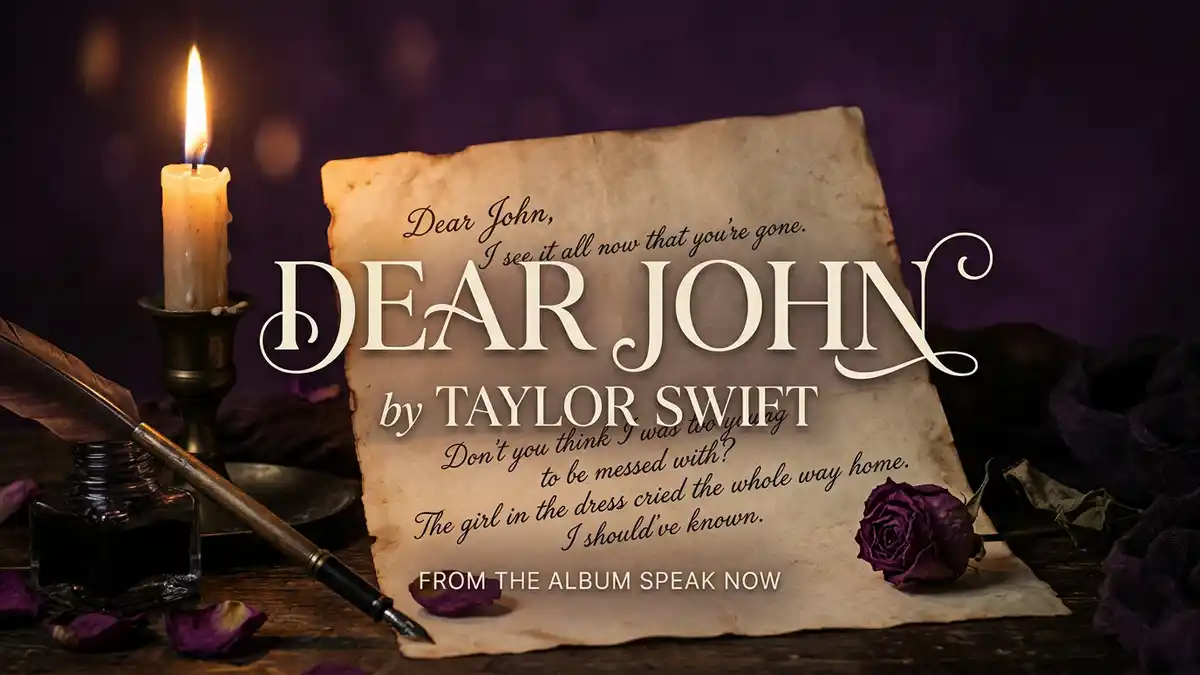

“Dear John” is a sprawling, six-and-a-half-minute emotional epic from Taylor Swift‘s third studio album, Speak Now (2010). The Dear John lyrics are widely believed to address Swift’s brief relationship with singer-songwriter John Mayer, painting a devastating portrait of a manipulative older boyfriend who took advantage of a younger woman’s naivety. Written solely by Swift, the song is one of the most personal and emotionally intense tracks in her entire catalog, and it remains a defining moment of the Speak Now era.
Table of Contents
About the Song
“Dear John” is the fifth track on Speak Now, released on October 25, 2010. At over six minutes long, it is one of the lengthiest songs Swift had recorded at that point in her career. Written solely by Taylor Swift and produced by Nathan Chapman, Swift, and Emily Mueller, the track is built on a foundation of Mayer-esque guitar work — a detail many listeners have interpreted as a deliberate stylistic choice to echo John Mayer’s own musical signature.
Swift and John Mayer first connected in 2009 when they recorded the duet “Half of My Heart” together for Mayer’s album Battle Studies. At the time, Swift was 19 years old and Mayer was 32 — an age gap that forms the emotional core of “Dear John.” Their relationship was short-lived, and Swift channeled her experience into what many consider one of her most powerful songs.
The title itself is a double entendre — “Dear John” is both a direct address to a person named John and a reference to the traditional “Dear John letter,” a breakup letter sent to end a relationship. This layered wordplay is characteristic of Swift’s songwriting approach, where titles and phrases often carry multiple meanings simultaneously.
John Mayer responded publicly to the song in a 2012 interview with Rolling Stone, saying it “humiliated” him and calling it “a really lousy thing to do.” He expressed particular frustration about the age references, noting that the song made him “feel terrible.” Swift, for her part, has never explicitly confirmed the song’s subject but has stated in interviews that the song’s meaning should be “pretty obvious.” The track peaked at number 26 on the Billboard Hot 100 and was certified 2x Platinum by the RIAA.
Dear John Lyrics
[Verse 1]
Long were the nights when
My days once revolved around you
Counting my footsteps
Praying the floor won’t fall through again
And my mother accused me of losing my mind
But I swore I was fine
[Verse 2]
You paint me a blue sky
And go back and turn it to rain
And I lived in your chess game
But you changed the rules every day
Wondering which version of you I might get on the phone tonight
Well, I stopped picking up and this song is to let you know why
[Chorus]
Dear John, I see it all now that you’re gone
Don’t you think I was too young to be messed with?
The girl in the dress, cried the whole way home
I should’ve known
[Verse 3]
Well, maybe it’s me
And my blind optimism to blame
Or maybe it’s you and your sick need
To give love then take it away
And you’ll add my name to your long list of traitors
Who don’t understand
And I’ll look back and regret how I ignored when they said “Run as fast as you can”
[Chorus]
Dear John, I see it all now that you’re gone
Don’t you think I was too young to be messed with?
The girl in the dress, cried the whole way home
Dear John, I see it all now, it was wrong
Don’t you think nineteen’s too young
To be played by your dark, twisted games when I loved you so?
I should’ve known
[Bridge]
You are an expert at sorry and keeping the lines blurry
Never impressed by me acing your tests
All the girls that you’ve run dry have tired lifeless eyes
‘Cause you burned them out
But I took your matches before fire could catch me
So don’t look now
I’m shining like fireworks over your sad empty town
[Chorus]
Oh, oh
Dear John, I see it all now that you’re gone
Don’t you think I was too young to be messed with?
The girl in the dress, cried the whole way home
[Outro]
I see it all now that you’re gone
Don’t you think I was too young to be messed with?
The girl in the dress wrote you a song
You should’ve known
You should’ve known
Don’t you think I was too young? You should’ve known
Meaning and Analysis
“Dear John” is one of the most emotionally devastating songs Taylor Swift has ever written, and its power comes from the specificity and clarity of its accusations. The song opens with an image of psychological torment — “long were the nights when my days once revolved around you” — establishing a relationship that consumed the narrator entirely. The detail that “my mother accused me of losing my mind” adds a layer of external validation to the narrator’s suffering; even the people closest to her could see the damage being done.
The second verse introduces the central metaphor of the relationship as a chess game: “I lived in your chess game, but you changed the rules every day.” This image of constantly shifting expectations and emotional manipulation is one of Swift’s most incisive descriptions of toxic relationship dynamics. The unpredictability — “wondering which version of you I might get on the phone tonight” — captures the exhausting reality of being involved with someone whose behavior is erratic and manipulative. The verse ends with a defiant declaration: “I stopped picking up and this song is to let you know why.”
The chorus’s most pointed line — “Don’t you think nineteen’s too young to be played by your dark, twisted games when I loved you so?” — directly addresses the age gap that troubled many observers of Swift and Mayer’s relationship. By specifying her age, Swift underscores the power imbalance at the heart of the relationship and shifts accountability firmly onto the older partner. The recurring image of “the girl in the dress” who “cried the whole way home” creates a portrait of lost innocence that is heartbreaking in its simplicity.
The bridge is where Swift transforms from victim to survivor. “I took your matches before fire could catch me” is a triumphant declaration of self-preservation, and “I’m shining like fireworks over your sad empty town” is a victory lap. The final shift in the outro — from “the girl in the dress cried the whole way home” to “the girl in the dress wrote you a song” — reframes the entire narrative. The narrator’s pain has been transmuted into art, into power, into the very song the listener is hearing. It is Swift at her most defiant, and it cemented “Dear John” as one of the most emotionally complex and artistically ambitious tracks on Speak Now.
FAQs
Is Dear John about John Mayer?
While Taylor Swift has never officially confirmed it, “Dear John” is widely believed to be about singer-songwriter John Mayer. Swift and Mayer had a brief relationship in 2009 when she was 19 and he was 32. The song references being nineteen, and the title itself is both a direct address and a play on the traditional ‘Dear John letter.’ Mayer confirmed he felt the song was about him in a 2012 Rolling Stone interview, saying it ‘humiliated’ him.
How long is the song Dear John?
“Dear John” runs over six minutes long, making it one of the lengthiest tracks Taylor Swift had recorded at the time. The extended runtime allows Swift to build a detailed emotional narrative through multiple verses, choruses, and a climactic bridge. The song’s length contributes to its epic, cathartic quality and has drawn comparisons to John Mayer’s own lengthy guitar-driven songs.
What does ‘the girl in the dress wrote you a song’ mean?
The final line of “Dear John” shifts from ‘the girl in the dress cried the whole way home’ to ‘the girl in the dress wrote you a song.’ This transformation represents Swift reclaiming her power — turning her pain into art. Instead of remaining a victim who cries, she becomes a songwriter who tells her story on her own terms. It is one of the most powerful closing lines in Swift’s catalog.
Did Taylor Swift write Dear John by herself?
Yes, “Dear John” was written solely by Taylor Swift with no co-writers. It was produced by Nathan Chapman, Taylor Swift, and Emily Mueller. The entire Speak Now album was self-written by Swift, who made a deliberate decision to prove she could write every track on her own after critics questioned her songwriting abilities.