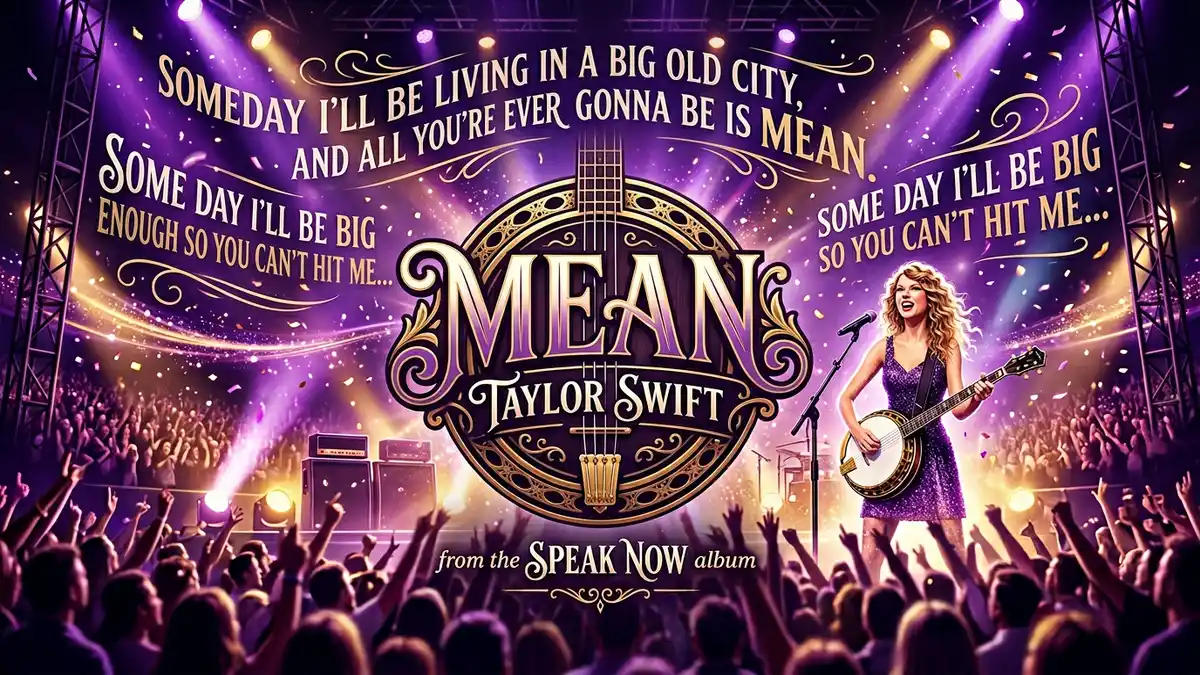

“Mean” is one of the standout tracks from Taylor Swift‘s third studio album, Speak Now (2010). The Mean lyrics were written as a direct response to a harsh music critic — widely believed to be blogger Bob Lefsetz — but the song transcended its origins to become a powerful anti-bullying anthem that resonated with millions of listeners worldwide. Written solely by Swift, “Mean” went on to win two Grammy Awards in 2012, proving that the best revenge truly is living well.
Table of Contents
About the Song
“Mean” was released as the third single from Speak Now on March 13, 2011. Written solely by Taylor Swift and produced by Nathan Chapman and Swift, the song features a distinctly bluegrass and country sound, with banjo and fiddle taking center stage — a deliberate musical choice that set it apart from the more pop-leaning tracks on the album. The song peaked at number 11 on the Billboard Hot 100 and was certified 5x Platinum by the RIAA.
Swift has stated that she wrote “Mean” in response to a particularly scathing review of her live performance at the 2010 Grammy Awards, where she performed alongside Stevie Nicks. The review, widely attributed to music industry blogger Bob Lefsetz, criticized Swift’s vocal abilities harshly. Rather than retreating from the criticism, Swift channeled her hurt into a song that turned the tables on her critic while also speaking to anyone who has ever been bullied or belittled.
The song’s impact extended far beyond the music industry. “Mean” became an anthem for anti-bullying campaigns, and Swift received thousands of letters from young fans telling her that the song helped them deal with bullying at school. She performed the song at the 54th Annual Grammy Awards in 2012, and that same night, “Mean” won two Grammy Awards: Best Country Song and Best Country Solo Performance. The irony of winning music’s highest honor with a song about a music critic was not lost on anyone.
The music video for “Mean,” directed by Declan Whitebloom, depicted various storylines of young people being bullied in different settings — at school, at work, in small towns — while imagining their future success. The video reinforced the song’s message that current circumstances do not define your future, making it one of the most emotionally impactful music videos of Swift’s early career.
Mean Lyrics
[Verse 1]
You, with your words like knives
And swords and weapons that you use against me
You have knocked me off my feet again
Got me feeling like a nothing
You, with your voice like nails on a chalkboard
Callin’ me out when I’m wounded
You, pickin’ on the weaker man
[Pre-Chorus]
Well, you can take me down
With just one single blow
But you don’t know what you don’t know
[Chorus]
Someday, I’ll be livin’ in a big old city
And all you’re ever gonna be is mean
Someday, I’ll be big enough so you can’t hit me
And all you’re ever gonna be is mean
Why you gotta be so mean?
[Verse 2]
You, with your switching sides
And your wildfire lies and your humiliation
You have pointed out my flaws again
As if I don’t already see them
I walk with my head down
Tryna block you out ’cause I’ll never impress you
I just wanna feel okay again
[Pre-Chorus]
I’ll bet you got pushed around
Somebody made you cold
But the cycle ends right now
‘Cause you can’t lead me down that road
And you don’t know what you don’t know
[Chorus]
Someday, I’ll be livin’ in a big old city
And all you’re ever gonna be is mean
Someday, I’ll be big enough so you can’t hit me
And all you’re ever gonna be is mean
Why you gotta be so mean?
[Bridge]
And I can see you years from now in a bar
Talkin’ over a football game
With that same big loud opinion, but nobody’s listening
Washed up and ranting about the same old bitter things
Drunk and grumbling on about how I can’t sing
But all you are is mean
All you are is mean
And a liar, and pathetic
And alone in life and mean
And mean, and mean, and mean
[Final Chorus]
But someday, I’ll be livin’ in a big old city
And all you’re ever gonna be is mean, yeah
Someday, I’ll be big enough so you can’t hit me
And all you’re ever gonna be is mean
(Why you gotta be so mean?)
Someday, I’ll be livin’ in a big old city (why you gotta be so mean?)
And all you’re ever gonna be is mean (why you gotta be so mean?)
Someday, I’ll be big enough so you can’t hit me (why you gotta be so mean?)
And all you’re ever gonna be is mean
Why you gotta be so mean?
Meaning and Analysis
“Mean” is both deeply personal and universally applicable, which is exactly why it became such a massive cultural touchstone. The song opens with vivid imagery of verbal attacks — “words like knives and swords and weapons that you use against me” — that captures the visceral pain of being publicly criticized. The description of the critic’s “voice like nails on a chalkboard” is not just an insult but an expression of how grating and inescapable negative criticism can feel when it is directed at you.
The pre-chorus introduces the song’s secret weapon: the line “but you don’t know what you don’t know.” This seemingly simple phrase carries enormous weight. It suggests that the critic lacks the self-awareness to understand their own cruelty, but also that they cannot foresee the narrator’s future success. It is both a dismissal and a prophecy, and it sets up the anthem-like chorus perfectly.
The second verse adds psychological depth by suggesting the bully’s behavior stems from their own pain: “I’ll bet you got pushed around, somebody made you cold, but the cycle ends right now.” This moment of empathy — even for someone who has caused her immense pain — is characteristic of Swift’s songwriting at its best. She acknowledges the possibility that meanness is a learned behavior while simultaneously refusing to perpetuate the cycle. The declaration “you can’t lead me down that road” is an act of emotional agency that elevates the song beyond simple revenge.
The bridge is where “Mean” reaches its most satisfying moment of catharsis. Swift paints a picture of the critic’s future — “washed up and ranting about the same old bitter things, drunk and grumbling on about how I can’t sing” — that contrasts sharply with her own envisioned future in a “big old city.” The final repetition of “all you are is mean, and a liar, and pathetic, and alone in life” strips away any pretense and delivers the full force of the narrator’s anger. The song’s legacy — two Grammy wins, millions of copies sold, and its adoption as an anti-bullying anthem — proved Swift’s prophecy resoundingly correct.
FAQs
Who is the song Mean by Taylor Swift about?
Taylor Swift wrote “Mean” in response to harsh criticism of her live vocal performance at the 2010 Grammy Awards. The critic is widely believed to be music industry blogger Bob Lefsetz, who published a particularly scathing review. Swift has confirmed the song was written about a specific critic but has not named them publicly. The song’s message transcended its origin to become a universal anti-bullying anthem.
How many Grammys did Mean win?
“Mean” won two Grammy Awards at the 54th Annual Grammy Awards ceremony in 2012: Best Country Song (a songwriter’s award) and Best Country Solo Performance. Taylor Swift performed the song live at the ceremony that same evening. The wins were seen as particularly poignant given that the song was written in response to a music critic — and the Grammys represent the music industry’s highest recognition.
What album is Mean on?
“Mean” appears on Taylor Swift’s third studio album, Speak Now, released on October 25, 2010. It was released as the third single from the album on March 13, 2011. The song peaked at number 11 on the Billboard Hot 100 and was certified 5x Platinum by the RIAA. A re-recorded version was included on Speak Now (Taylor’s Version) in July 2023.
Why did Mean become an anti-bullying anthem?
“Mean” resonated as an anti-bullying anthem because its message extends far beyond music criticism. The song’s themes of being knocked down by someone’s cruelty, refusing to let it define you, and believing in a better future spoke directly to young people experiencing bullying at school and in their daily lives. Taylor Swift received thousands of letters from fans who said the song helped them cope with bullying, and the music video depicted multiple storylines of young people overcoming different forms of bullying.